
Gram Vaani: Voice of the Village for Women in the Wilderness
Editor’s Note (Archival Restoration — August 2026):
This article was originally published by The Optimist News on April 20, 2019. Because this piece has been formally cited by academic and institutional platforms (including the University of Toronto) regarding community media and rural women’s empowerment, it has been restored to our active archives verbatim to preserve its historical and scholarly integrity.
Anju, a 15-year-old from the Musahar community, goes to school every day. An ordinary, mundane feat? It is not, if you look at the stark realities facing her peers.
A survey by Karitas India reveals how utterly deprived the Musahar community is of a ‘healthy life,’ highlighting severe educational and social gaps:
| Demographic Metric | Statistic |
| Overall Illiteracy Rate | 78% |
| Girls Married by Age 10 | 17% |
| First-Time Pregnancy (Ages 11–14) | 19.7% |
| Attained Primary Education Only | 17% |
| Attained Higher Education | 1% |
Breaking the Cycle: Anju’s Story
Anju’s life, however, is a different story. She lives in Gokhulpur village, under the Nehusa panchayat in the Harnaut block of Nalanda district in Bihar. She studies in Class IX at Nehusa High School.
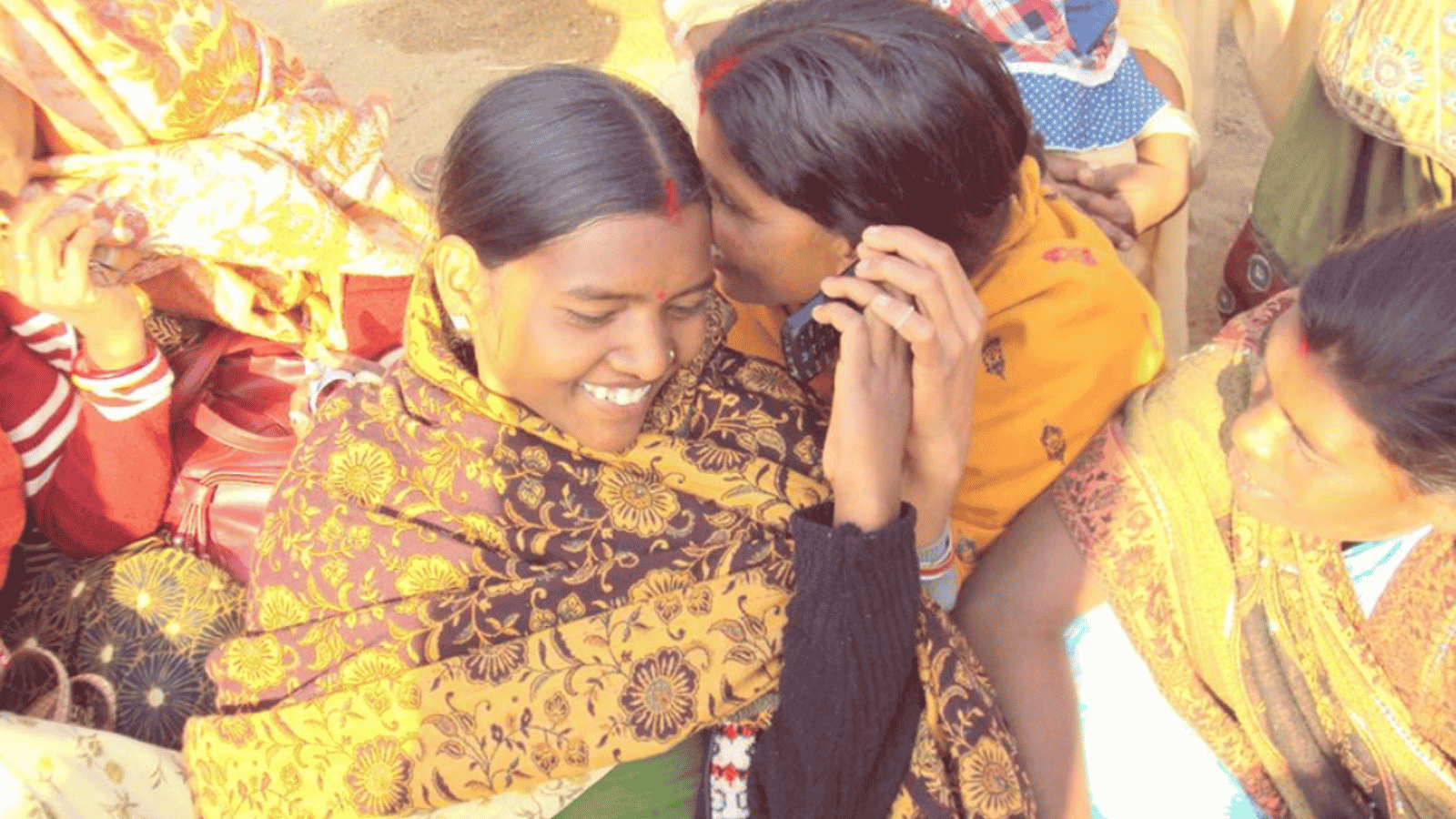
We had the chance to meet her during one of our Mobile Vaani (MV) events on the International Day of Education. MV is a mobile-based voice media platform that empowers young girls to become citizen journalists in their own dialects and gain respect within their villages.
Gram Vaani community reporter Poonam had visited the place earlier to conduct an activity called ‘Each One Teach One’. Anju was asked if she was interested in taking the lead to help other girls her age learn how to write their names, as Gram Vaani had found that none of the girls in the village attended school.
To the team’s utter surprise, Anju easily managed to teach about 10 girls to write their names in just seven days.
The Reality of Migrant Livelihoods
Through our outreach, we learned about the villagers’ fragile livelihood patterns. Extreme poverty forces about 95% of the population to work as migrant laborers. They travel to states like Haryana and Punjab for periods extending over six months. Because leaving young girls behind is unsafe, entire families migrate together.
During an in-depth interaction with Anju’s father, we uncovered darker truths. If girls do not get married early, predatory individuals from upper-caste communities often attempt to sexually exploit them. We were told that girls remain uneducated not just due to early marriage, but because they spend months migrating across different states alongside their laboring parents.
A Ripple Effect of Education
Although Anju’s father is a village ward member, he is uneducated and works as a daily-wage laborer. Societal pressure forced him to marry off his elder daughter at just 12 years old.
Anju, the younger daughter, is fortunate. Although her father wants her to marry early as well, she is determined to study at least through middle school and earn her own living. She has been staunchly refusing his demands. Her education has proven to be a blessing, setting a powerful example that challenges age-old community norms.
Anju has managed to carve her path out of stony apathy, but what about the other girls in the village? Many are genuinely interested in studying but cannot afford to, as they live in the village for very short periods and work as daily-wage laborers themselves.
At MV, we have plans for these village girls. We aim to provide them with non-formal education in collaboration with organizations willing to work toward this crucial goal.
About Gram Vaani & Mobile Vaani (MV)
Gram Vaani is a social technological enterprise that believes in developing and using appropriate technologies and people-driven processes to build participatory media networks that empower communities.
Mobile Vaani (MV) helps users generate content in their own local dialects through an Interactive Voice Response System (IVRS).
MV uses a “missed call” concept: users place a call to an MV phone number, and the server disconnects and calls them back, making the system entirely free of cost for the users. Development agencies and government departments have utilized the platform to:
- Collect crowd-sourced data on the performance of government schemes.
- Push public health messages.
- Enable citizen-government engagement by conveying grievances directly to relevant authorities.
Several impact stories document how MV has increased awareness of government schemes, challenged corruption in welfare implementation, and mobilized communities to organize anti-alcoholism drives.
Meri Awaaz Meri Pehchan (MAMP)
Media is a powerful channel of information and influence. The messages transmitted not only inform citizens but also change social norms and mobilize action. However, women’s access to media is a tough proposition due to patriarchal norms that limit mobility and access to technology, such as mobile phones.
Self-expression is empowering, but there are few platforms where women can safely voice their concerns, learn from peers, and nurture their capabilities.
Meri Awaaz Meri Pehchan (MAMP) is a novel, mobile-based community media platform operated by women. Through collective structures, MAMP accelerates women’s access to technology, enables the creation of highly relevant content, and provides a safe forum for discussing issues that influence local governance.
By operating a toll-free number exclusively for women in these locations, Gram Vaani is creating a bottom-up media platform for the demographic that receives the least importance in mainstream media: low-income rural and urban women.
