
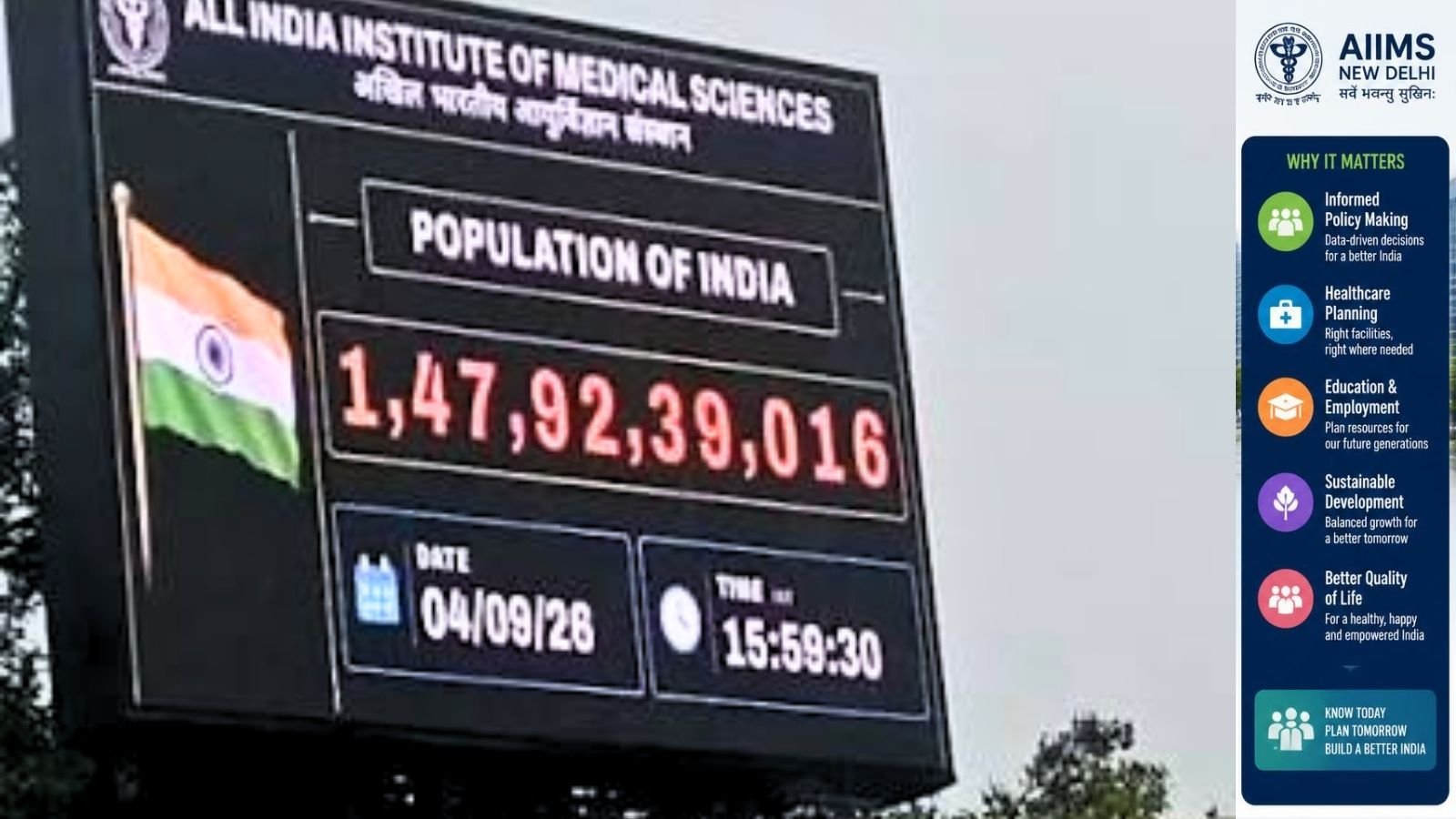
AIIMS Delhi’s Population Clock: Understanding Demographic Planning
A video of a digital population clock at the All India Institute of Medical Sciences (AIIMS) in New Delhi has recently gone viral, capturing the attention of millions. Recorded in early September 2026, the large digital display labeled “Population of India” showed the country’s population ticking upwards in real-time, crossing the 1.48 billion mark.
While social media reactions have largely centered around shock value and panic over “overpopulation,” the reality behind this digital counter is much more constructive. For premier medical and governmental institutions, this clock is not a warning siren—it is a vital metric for public policy, infrastructure planning, and unlocking India’s demographic dividend.
The Science Behind the Screen
The most common misconception surrounding the viral AIIMS display is that it operates as an exact, live headcount. It does not.
Because India’s last official and completed population census was conducted in 2011, government bodies and healthcare planners rely on advanced demographic projections until updated census data is fully processed and released.
- How Population Clocks Work: These digital counters use algorithms based on established national birth and death rates to project how the population changes over time.
- Why It Ticks: By dividing annual demographic estimates down to the second, the clock creates a striking visual reminder of statistical growth.
Demographic Projections vs. Real-Time Headcounts
| Feature | Algorithmic Population Clock | Literal Headcount (Census) |
| Data Source | Projected birth, death, and migration rates. | Direct door-to-door surveying and civil registration. |
| Update Frequency | Ticks continuously based on mathematical averages. | Updated cyclically (historically every 10 years). |
| Primary Utility | Visualizes growth for immediate resource allocation and awareness. | Provides deep socio-economic, housing, and granular civic data. |
Why AIIMS Needs a Population Clock
Placing this display at AIIMS New Delhi, India’s apex medical research and public health institute, is a highly strategic move. It serves as a constant, visual reminder to medical professionals, researchers, and policymakers of the scale at which Indian healthcare must operate.
The Ministry of Health and Family Welfare (MoHFW) and associated health bodies use these demographic estimates to calculate the required number of hospital beds, vaccine distributions, and medical staff necessary to maintain public health standards. When the population scales up, the infrastructure must scale with it. We see this proactive scaling in urban development initiatives as well, such as the comprehensive frameworks outlined in the Delhi Master Plan 2047 to accommodate growing housing and transit needs.
Shifting the Perspective: The Demographic Dividend
Instead of viewing 1.48 billion people purely as a strain on natural resources, global economic experts and the Indian government increasingly view this growing demographic as an unparalleled asset.
According to data tracked by organizations like the United Nations Population Fund (UNFPA), India possesses one of the youngest populations in the world. This massive working-age demographic translates into what economists call a “demographic dividend.”
Here is how a rising population, when properly managed and skilled, serves as a catalyst for national growth:
- Technological Scaling: A large population provides a massive domestic market that drives digital adoption. The unprecedented success of digital public infrastructure, built largely by small merchants adopting UPI, proves that sheer numbers can rapidly accelerate digital economies.
- Innovation and STEM: With more youth entering higher education, India’s human capital is expanding. Initiatives that push for equity, such as programs championing women in STEM at IIT Delhi, ensure that this massive population translates into a highly skilled, global workforce.
- Global Workforce Supply: As many Western and East Asian countries face aging populations and shrinking workforces, India’s demographic curve positions it as the primary supplier of global talent in medicine, engineering, and digital services.
Planning for the Future
The viral video of the AIIMS population clock has successfully turned an abstract statistic into something tangible that citizens can watch change before their eyes. Rather than inciting fear, it should inspire a pivot in how we discuss civic responsibility and government planning. By understanding the data behind the screen, we can better appreciate the massive logistical achievements of Indian healthcare and recognize that with strategic policy, a growing population is the ultimate engine for innovation.
