
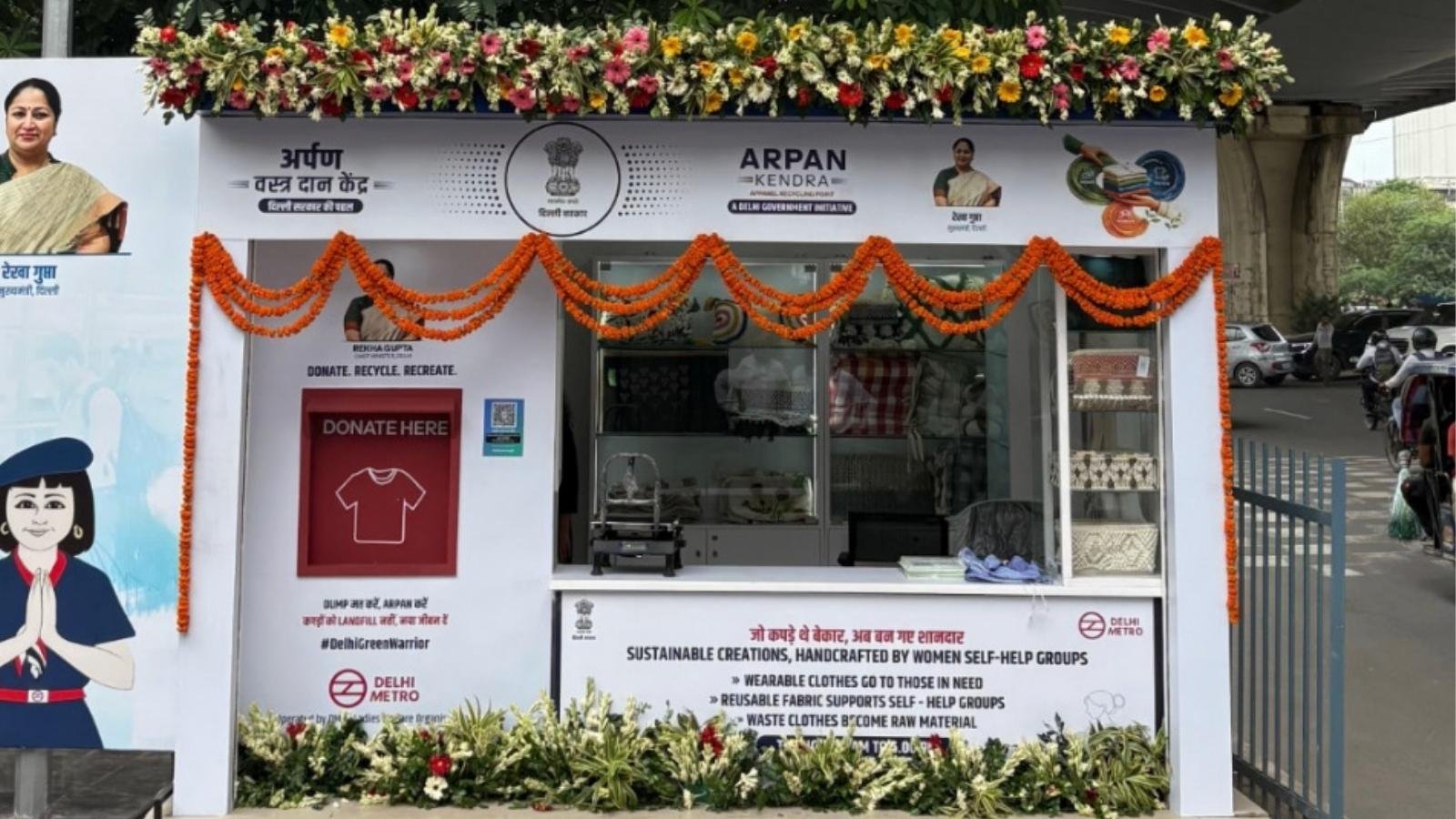
Revamping Urban Sustainability: The Impact of Delhi Metro’s Arpan Kendra Clothes Donation Drive
The city of Delhi is pioneering a major shift in urban sustainability with the widespread rollout of the Arpan Kendra textile donation initiative across its sprawling transit network. Formally launched by Delhi Chief Minister Rekha Gupta, this public-private eco-alliance represents an innovative method for addressing textile waste. Operating inside critical transport intersections managed by the Delhi Metro Rail Corporation (DMRC), these tech-enabled hubs provide daily commuters with a seamless opportunity to clear out unused garments responsibly.
In its opening phase alone, the program successfully diverted over 41 tonnes (41,181 kg) of clothes from metropolitan landfills. By converting massive volumes of solid urban waste into community resources, the Delhi Metro network is setting a template for circular economies in megacities—a crucial step for a city already navigating the complexities of its Winter Pollution Action Plan.
Understanding Arpan Kendras: Delhi’s Solution to Textile Waste
An Arpan Kendra is a specialized, tech-driven collection kiosk designed to gather old, unused, or surplus fabrics. The core framework operates on an official Memorandum of Understanding (MoU) signed at the Delhi Secretariat. This coalition unites the Delhi Government, the DMRC, and the Delhi Metro Ladies Welfare Organisation alongside experienced civil society actors like the Clothes Box Foundation and the processing network ReSpun.
Fast fashion and rapid urban consumption—topics we recently explored in our feature on sustainable fashion growth in India—have turned old apparel into a severe burden for city landfills. Traditional municipal waste channels often fail to segregate textiles properly, leading to microplastic contamination and clogged drainage lines. By positioning these centers at the heart of Delhi’s mass transit grid, the project aligns closely with the goals of the Swachh Bharat Mission (Urban), transforming cloth recycling from an occasional chore into an accessible, everyday habit.
| The Arpan Kendra Partnership | |
| DMRC & Gov Infrastructure | Civil Society Support |
| • Public Transit Stations | • Clothes Box Foundation |
| • Women-Led SHG Kiosks | • ReSpun Recyclers |
The Leadership and Vision Behind the Initiative
The foundation of the initiative stems from a collaborative execution framework. Chief Minister Rekha Gupta explicitly stated that the overarching goal of Arpan Kendras is to re-engineer what it means to build a “Viksit Delhi” (Developed Delhi). During the flagship inauguration, she highlighted that a progressive capital—much like the visions outlined in the Delhi Master Plan 2047—is not defined merely by constructing new roads, flyovers, and concrete metro rails. Instead, the true measure of urban advancement is creating environmentally responsible citizens who respect finite resources.
The primary objectives established by the founding coalition include:
- Preventing Landfill Saturation: Diverting thousands of tonnes of household municipal fabric waste directly from urban garbage dumps.
- Conserving Natural Wealth: Lowering carbon footprints, water consumption, and industrial energy expenditures by recycling pre-existing fibers rather than manufacturing new fast-fashion materials.
- Socio-Economic Elevation: Systematically training and employing marginalized women via local Self-Help Groups (SHGs) to manage high-tech logistics and secure financial autonomy.
Step-by-Step Guide: How to Donate at an Arpan Kendra
The initiative has completely replaced standard, unmonitored drop-boxes with a transparent, 4-step digitized workflow:
- Drop-Off: Donors hand over their unneeded apparel directly to the kiosk attendants. The program accepts wide-ranging household items, including denims, shirts, winter jackets, undergarments, bedsheets, and old pillow covers.
- Weighing: Attendants, who are women sourced from local Self-Help Groups (SHGs) and formalizing their income much like the workers registering under the e-Shram card benefits program, weigh the bundle at the desk using calibrated electronic scales.
- Digital Logging: Rather than filling out manual logs, citizens scan an official QR code on display at the counter. This code opens a fast digital form where the donor notes their name, active telephone number, and the exact weight recorded.
- E-Receipt Generation: Once submitted and verified, an automated digital donation e-certificate is issued directly to the citizen’s mobile screen, validating their contribution to the capital’s green transition.
Guidelines: What is Accepted vs. Rejected?
To maintain an efficient sorting and recycling loop, the collection hubs enforce strict quality benchmarks.
- Allowed Items: Clean clothes of all kinds (shirts, trousers, sarees, winter garments, sweaters), old blankets, curtains, bedsheets, pillowcases, and clean, dry fabrics.
- Rejected Items: Damp, wet, or moldy clothes (which ruin entire batches of dry fabric), shoes and footwear, bags and luggage, soiled mattresses, or fabric heavily stained with grease, paint, or chemical hazards.
Mapping the Network: Active Kiosk Locations and Timing Data
To serve diverse geographical demographics, the initiative launched across 10 major transit nodes. Each kiosk operates systematically from 7:00 AM to 7:00 PM daily (with specific partner counters active from 9:00 AM to 6:00 PM), allowing people to donate effortlessly during morning and evening rush hours.
| West / North Delhi | South / Central Delhi | East Delhi |
| • Punjabi Bagh West | • Lajpat Nagar | • Mayur Vihar Ph-1 |
| • Shalimar Bagh | • Malviya Nagar | • Shahdara |
| • Rohini West | • Mohan Estate | |
| • Dwarka | • Hauz Khas |
Statistical data gathered at the end of the initial collection wave highlights remarkable civic engagement. The Dr. Baba Saheb Ambedkar Hospital Metro Station (Rohini West) led the citywide charts, generating an exceptional 9,861 kg of discarded fabrics. The Shalimar Bagh kiosk followed closely behind, accumulating 9,761 kg. Meanwhile, flagship hubs like Punjabi Bagh West (Near Gate 2) and Mayur Vihar Phase-1 (Near Gate 2) maintain steady, daily traction from multi-line commuters.
Closing the Loop: Social Empowerment and Upcycling Metrics
The Arpan initiative extends well beyond trash diversion. Similar to community-driven environmental efforts like the recent Yamuna river clean-up drives, it is structured as a dual engine for environmental remediation and structural social upskilling.
The Recycling Grid: Wearable apparel items are sent for washing, restoration, and targeted distribution to underprivileged communities. Severely damaged or non-wearable fabrics are processed by ReSpun, where industrial machines shred them back into raw fiber or spinning yarn. These fibers are subsequently handcrafted into consumer-ready upcycled items like durable floor rugs, office folders, laptop pouches, and tote bags.
Economic Independence for Women: Every Arpan Kendra kiosk is managed by women-led SHGs. These operators handle daily intake logistics, manage the digital tracking dashboard, and sell the upcycled products directly from the metro storefronts. The program has generated over ₹27,036 in localized artisan retail sales, channeling all profits back into sustainable livelihoods and technical training for marginalized women.
Our Core Takeaway: Redefining “Waste”
The most vital lesson from the success of the Arpan Kendras is that urban waste is simply a resource looking for the right channel.
In an era dominated by rapid fashion consumption, discarding textiles directly into household trash bins creates severe long-term environmental degradation. The Arpan model proves that when a government provides decentralized, accessible, and transparent infrastructure, citizens will gladly shift away from wasteful habits. It shifts the environmental burden away from institutional cleanup and transforms it into a shared community responsibility.
What to Do: A Guide for Citizens
A major collaborative driver of this initiative, the Clothes Box Foundation, has introduced an active “60,000 Kg in 60 Days” winter clothing challenge across Delhi. As seasonal drops approach, citizens can actively engage with the circular economy using the following steps:
Gather and Prep Your Contribution
- Audit Your Closet: Pull out unneeded garments, ranging from shirts, jeans, and heavy winter coats to household textiles like bedsheets and pillow covers.
- Enforce Quality Control: Double-check that all items match the required parameters (clean, bone-dry, and completely free of footwear or garbage).
Choose Your Channel
- Metro Drop-Off (In Delhi): Head directly to active hubs like Lajpat Nagar, Mayur Vihar Phase 1, Malviya Nagar, Mohan Estate, or Dwarka to drop off your bundle in person.
- Pan-India Doorstep Pickup: If you reside outside Delhi or have larger bundles that are difficult to carry on a train, you can visit the official Clothes Box Foundation Website to easily schedule a convenient doorstep collection right from your home.
By executing these steps, your unwanted wardrobe items are instantly transformed into vital winter layers for underprivileged communities or high-value raw material for creative upcycling artisans.
