
Elite Education: The Definitive Guide to the Top 5 Schools in Delhi NCR (2026–2027)
The top five most consistently acclaimed schools in Delhi NCR—The Shri Ram School, Vasant Valley School, Delhi Public School R.K. Puram, Step by Step School, and Sanskriti School—dominate national rankings through a blend of rigorous academics, world-class infrastructure, and holistic student development. Securing a seat in these institutions requires navigating complex Directorate of Education (DoE) guidelines, understanding international board integrations, and tracking strict admission timelines.
This comprehensive guide breaks down the institutional legacies, the newly mandated National Education Policy (NEP) age criteria for 2026-2027, infrastructure benchmarks, and the stringent anti-bullying protocols that make these five schools the absolute gold standard in Indian education.
Table of Contents
1. Institutional Legacies: Why These 5 Schools Dominate
These institutions did not merely build massive campuses; they fundamentally re-engineered Indian pedagogical methods.
- The Shri Ram School (Vasant Vihar, Delhi & Moulsari/Aravali, Gurugram): Founded by Manju Bharat Ram in 1988 under the SRF Foundation, this institution broke away from traditional rote-learning systems. It pioneered an incredibly progressive, child-centric environment with a massive emphasis on inclusive education for children with special needs. It frequently ranks at the very top for holistic development and teacher-student engagement.
- Vasant Valley School (Vasant Kunj, New Delhi): Established in 1990 by the India Today Group, Vasant Valley was born out of a vision to combine intense academic discipline with a highly expressive creative arts culture. It revolutionized early education by refusing to rank children publicly in their formative years, heavily reducing childhood mental stress while maintaining peak academic outcomes.
- Delhi Public School, R.K. Puram (New Delhi): Founded in 1972 by the Delhi Public School Society, DPS R.K. Puram is a historic powerhouse. It engineered a hyper-competitive academic atmosphere that reliably secures top positions in India’s hardest national competitive exams (IIT-JEE, NEET, CUET). Its extra-curricular scale is equally massive, often hosting national-level events like DPS R.K. Puram’s Theatron festival.
- Step by Step School (Noida, Uttar Pradesh): Launched in 2008, Step by Step rapidly scaled to become Noida’s premier educational hub. It achieved this by implementing premium, corporate-scale infrastructure coupled with highly progressive global boards, offering unparalleled support for diverse learning needs.
- Sanskriti School (Chanakyapuri, New Delhi): Founded in 1998 by the Civil Services Society, this school was explicitly built to solve the issue of high-ranking Indian bureaucrats and diplomats constantly relocating to Delhi. It matches elite international tier facilities with a deeply grounded Indian curriculum, providing stability and elite education for the children of government officials and general category students alike.
Direct Institutional Overview
| School | Primary Board | Location | Key Strength |
| The Shri Ram School | ICSE / IB | Delhi & Gurugram | Progressive learning & inclusivity |
| Vasant Valley School | CBSE | South Delhi | Co-curriculars & individualized attention |
| DPS R.K. Puram | CBSE | South Delhi | Highly competitive academics & STEM |
| Step by Step School | CBSE / IB | Noida | Exceptional infrastructure & sports |
| Sanskriti School | CBSE | Central Delhi | Elite faculty & holistic curriculum |
2. Curriculum Integration and International Boards
While traditional CBSE and ICSE boards remain the backbone of the Indian education system, the demand for international curricula has transformed how these top schools operate.
- The Shri Ram School (Moulsari Campus): Operates as a highly prominent IB World School, offering the rigorous International Baccalaureate Diploma Programme (IBDP) for Grades 11 and 12 alongside its traditional ICSE framework.
- Step by Step School: Features a deeply integrated international wing offering the IGCSE (Cambridge) track for middle years, seamlessly transitioning into the IBDP for senior years.
- DPS R.K. Puram: The primary campus in R.K. Puram is strictly affiliated with CBSE, focusing heavily on national engineering and medical entrances. However, parents seeking global tracks within the same society often look toward the DPS International Gurugram admission guide for pure Cambridge and IB curriculum paths.
- Vasant Valley and Sanskriti School: Both remain fiercely loyal to the CBSE board but utilize highly advanced, internationally modeled pedagogies (like flipped classrooms and research-based continuous assessments) to deliver the national curriculum.
3. The New DoE Age Criteria (2026–2028 Implementations)
For parents targeting entry-level admissions (Nursery), the landscape is undergoing a massive shift. The Delhi Government’s Directorate of Education (DoE) has officially restructured the Foundational Stage to align with the NEP 2020.
Starting in the 2026–2027 academic session, a strict 6+ years age rule for Class 1 is being implemented in a phased manner. The foundational stage is now divided into three pre-primary years (Balvatika 1, 2, and 3).
Updated Age Requirements (As of March 31 of the Admission Year)
| Class / Stage | Minimum Age | Age Range |
| Nursery (Balvatika 1 / Pre-School 1) | 3+ years | 3 to <4 years |
| Lower KG (Balvatika 2 / Pre-School 2) | 4+ years | 4 to <5 years |
| Upper KG (Balvatika 3 / Pre-School 3) | 5+ years | 5 to <6 years |
| Class 1 | 6+ years | 6 to <7 years |
Important Implementation Nuances:
- Phased Rollout: The changes begin in 2026-27, meaning children entering Nursery at 3+ years in 2026 will be the first batch to officially enter Class 1 at 6+ years in 2029-30.
- Exemptions for Existing Students: Children who have already passed the previous class (e.g., currently in KG) and possess a valid School Leaving Certificate are exempted from the new age-appropriate criteria for their transition into Class 1.
- Age Relaxation: School heads maintain the discretionary power to grant an age relaxation of up to one month in both the minimum and maximum age limits for admissions from Nursery to Class 1.
4. Admission Criteria and 2027–2028 Timelines
Securing a seat requires acute awareness of the varying regulatory frameworks between Delhi proper and the wider NCR regions.
- Delhi Schools (Vasant Valley, Sanskriti, DPS RKP): These institutions are bound by the DoE’s strict 100-Point System for entry-level admissions. Points are allocated based on neighborhood proximity (distance from the school yields the highest points), sibling enrollment, and alumni status. No written testing, parent profiling, or interviews are legally permitted for Nursery admissions. The formal registration window for the 2027–2028 batch is expected to open between late November and mid-December 2026.
- NCR Schools (Step by Step Noida, Shri Ram Gurugram): Operating outside Delhi’s municipal jurisdiction, these schools follow independent point grids and conduct soft interaction sessions to gauge school-family alignment. Step by Step generally opens its Montessori application window early in September, while The Shri Ram School (Aravali) launches Pravesh Vatika registrations around July/August of the preceding year. Parents missing these windows often explore parallel elite options, such as the Heritage International Xperiential School Admissions cycle.
Admissions for Classes 2 to 9 (Mid-Level Transfers)
While Nursery admissions are governed by a strict point system, gaining admission into Classes 2 through 9 in these five elite schools operates on a completely different framework.
- Purely Vacancy-Driven: Retention rates at schools like Vasant Valley, Sanskriti, and Step by Step are near 100%. Seats in higher classes only open up if a current student relocates to another city or transfers out.
- The Admission Timeline: If a vacancy does arise, schools typically announce it on their official notice boards and portals between February and March, just before the new academic session kicks off in April.
- The Testing Protocol: Unlike Nursery (where testing is legally banned), mid-level admissions require the student to pass a rigorous written entrance examination. This usually covers core subjects like Mathematics, English, and Science based on the syllabus of the preceding class.
- The Final Step: If the student clears the written cutoff, both the child and the parents are called in for a detailed interaction with the Principal or Head of Middle/Senior School, alongside a strict review of their past two years of academic report cards and behavioral records.
Senior Secondary Admissions: Classes 10, 11, and 12
Admissions into the senior-most classes are treated very differently due to the strict regulations of the national boards (CBSE and CISCE) and the high stakes of university placements.
Classes 10 and 12 (The Board Years): Almost Impossible
- The Board Restriction: CBSE and ICSE regulations strictly discourage students from changing schools during their actual board examination years (Class 10 and Class 12).
- The Exceptions: The only way a student can secure admission into these classes at schools like Vasant Valley, Sanskriti, or DPS is under highly specific emergency criteria. This usually requires proof of a parent’s sudden job transfer (especially for defense or government officials) or a family’s geographical relocation from another state.
- The Approval Process: Even if the school has a vacancy, the admission must be formally approved by the regional office of the respective board, accompanied by the student’s previous registration cards and transfer certificates.
Class 11 (The Merit Intake): The Second Biggest Window. Unlike the restricted board years, Class 11 is the second-largest admission window after Nursery. Because students are selecting their career streams (Science, Commerce, Humanities, or IB DP), schools actively open their doors to external talent.
- DPS R.K. Puram’s Massive Intake: DPS R.K. Puram is famous nationwide for its Class 11 admissions. They actively recruit top-tier academic performers from across the country who are looking for intensive IIT-JEE and NEET environments.
- Provisional vs. Final Admission: External Class 11 admissions typically begin in April/May, right after the Class 10 board exams conclude. Schools grant provisional admission based on a rigorous written entrance test and the student’s Class 9 and pre-board report cards.
- The Final Cutoff: The admission is only formalized once the official Class 10 board results are declared in May/June. If the student fails to meet the school’s strict percentage cutoff for their chosen stream (which often hovers above 90% for Science and Commerce in these elite tier schools), the provisional admission is revoked.
This perfectly rounds out the entire admission lifecycle—from a 3-year-old entering Pravesh Vatika to a 16-year-old transferring in for their board exams.
5. Faculty Excellence and Teaching Standards
The benchmark for faculty across these five schools is exceptionally high. Teachers do not merely hold basic B.Ed. degrees; a significant majority possess postgraduate qualifications (M.A., M.Sc., M.Phil.) in their specific domains. Furthermore, for schools executing international programs (The Shri Ram, Step by Step), educators undergo mandatory, rigorous IB and IGCSE-certified training workshops directly authorized by the international boards to ensure global teaching standards are met.
6. Campus Infrastructure: Academics, Sports, and Amenities
These schools are designed to function as self-sustaining academic cities, providing infrastructure that rivals premier undergraduate colleges.
- Air-Conditioned Comfort: Every single one of these schools features fully air-conditioned classrooms across their primary and senior campuses to combat the severe, exhausting Delhi summers, ensuring students remain focused.
- Assembly Grounds: All five feature massive central courtyards or state-of-the-art indoor auditoriums capable of hosting thousands of students for morning assemblies, theatrical plays, and national award ceremonies.
- Sports Infrastructures:
- Step by Step: Boasts massive synthetic athletic tracks, indoor heated swimming pools, dedicated squash courts, and professional cricket nets.
- DPS R.K. Puram: Famous for its full-sized football fields, professional lawn tennis courts, and a heavily utilized semi-olympic swimming pool.
- The Shri Ram & Vasant Valley: Feature world-class indoor multi-sport halls engineered for badminton and basketball, alongside gymnastics facilities and specialized yoga studios.
7. School Uniforms and Dress Codes
The philosophy of the school is often reflected in its uniform design.
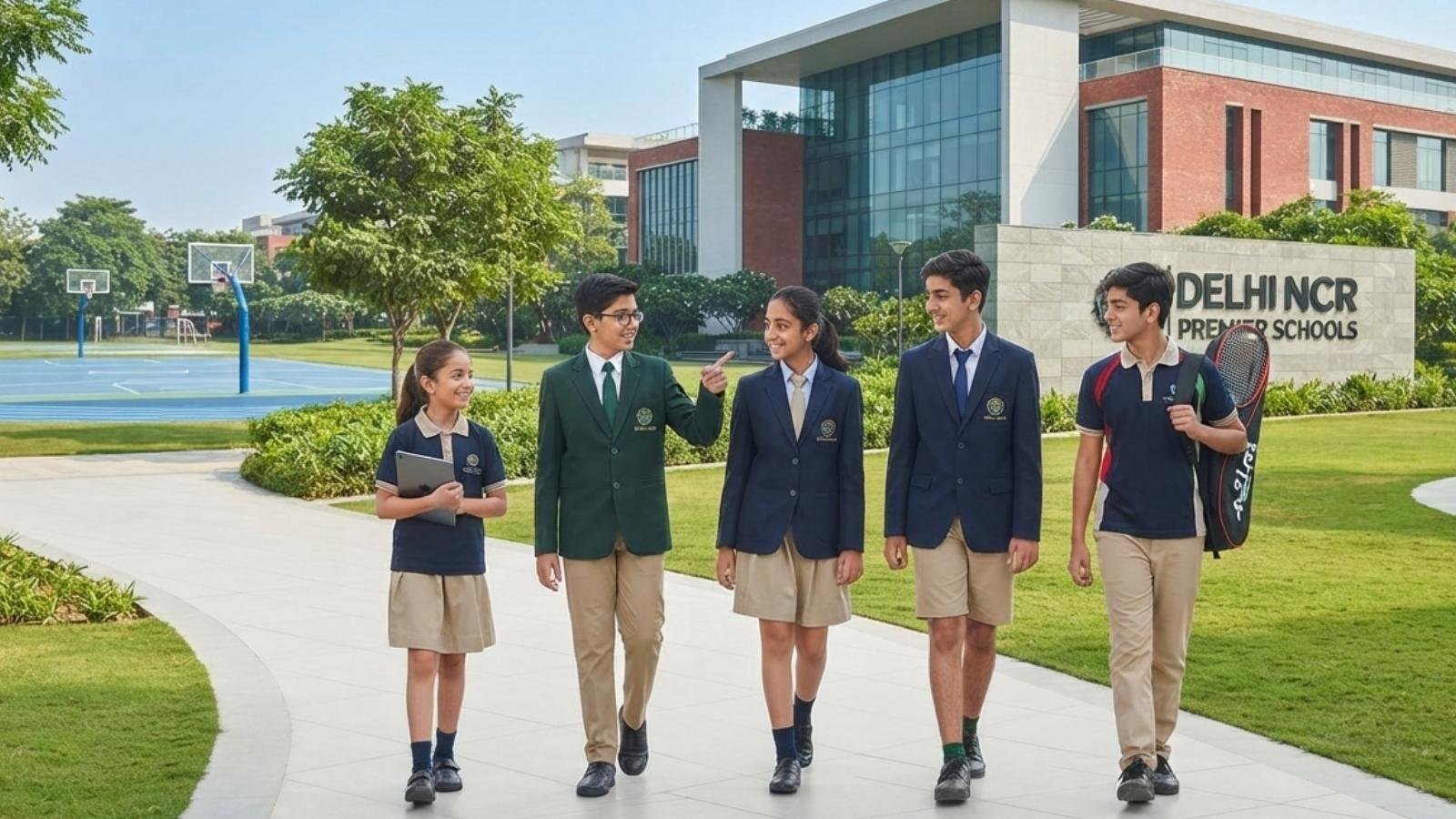
- Modern & Functional: The Shri Ram School and Step by Step utilize highly functional, comfortable uniforms. Students wear breathable polo t-shirts and comfortable trousers, skorts, or skirts engineered for active, daily movements rather than rigid formality.
- Traditional & Corporate: DPS R.K. Puram and Sanskriti maintain a classic, formal aesthetic. Students don crisp white shirts, signature green blazers for DPS (or navy blue/grey accents for Sanskriti), complete with specific institutional neckties and belts, instilling a sense of corporate discipline.
8. Nutrition: Mid-Day Meals and Cafeterias
Managing the dietary needs of thousands of students requires military-grade logistics. The policies vary strictly depending on the school’s location and structure.
- Mandatory Meal Programs (The Shri Ram School & Step by Step): These schools feature compulsory, state-of-the-art in-house cafeteria programs managed by premium catering services. Students receive highly nutritious, balanced vegetarian breakfasts, mid-day snacks, and hot lunches. Menus rotate every 7 to 14 days and are kept completely free of heavily processed trans-fats and artificial coloring. Dedicated dietary kitchens manage severe nut and gluten allergies.
- Tiffin Culture (Vasant Valley, Sanskriti, DPS RKP): These operate primarily as day-scholar spaces where students bring home-cooked meals. However, they house highly regulated on-campus cafeterias and tuck shops that sell healthy snacks, fresh juices, and hot meals under strict hygiene guidelines.
9. Transportation and Personal Vehicle Policies
Transit safety in the NCR is paramount. All five schools provide elite, GPS-tracked transportation networks.
- The Bus Fleet: Schools operate massive fleets of eco-friendly, fully air-conditioned buses covering almost all major sectors of Delhi, Noida, and Gurugram. In strict alignment with Supreme Court safety guidelines, every bus is equipped with CCTV cameras, speed governors, first-aid kits, and fire extinguishers. A female guard, a conductor, and at least one designated school teacher are mandatorily on board during all routes.
- Transport Fees (2026-2027 Estimates): Central Delhi routes for Vasant Valley or DPS average ₹2,500 to ₹5,000 per month. Cross-border NCR routes (e.g., traveling from South Delhi to Step by Step Noida) scale higher, ranging from ₹7,200 to ₹8,700 per month due to toll and distance parameters.
- Personal Vehicle Bans: Under no circumstances are students legally allowed to drive self-geared motorized vehicles (cars or motorbikes) to school. Because students under 18 do not possess permanent driver’s licenses, violating this rule results in immediate vehicle confiscation and suspension. Bicycles are permitted for neighborhood zones, and some schools conditionally allow 16-year-old seniors to ride gearless 50cc electric scooters, provided they hold a valid learner’s license and submit a parental indemnity bond.
10. Student Safety, Cyber Ethics, and Anti-Bullying Mandates
Delhi NCR’s top-tier schools take an aggressive, zero-tolerance stance against bullying, ragging, and cyber-harassment.
- Anti-Bullying Committees: Every school mandates a dedicated Peer Support and Anti-Bullying Committee consisting of the principal, a legal counselor, parent representatives, and senior student council members. Anonymous reporting boxes are strategically placed across campuses.
- Digital Sensitization: As children spend more time online, the psychological impact of social media is heavily monitored. Alongside advising parents on why kids should be descreened at home, schools integrate digital safety and cyber ethics workshops into the monthly academic calendar.
- Punitive Measures: The disciplinary matrix is strict. A first offense triggers mandatory parental summons and behavioral counseling. A second offense results in formal academic and transport suspension. Severe or repeated structural bullying leads to immediate expulsion with a negative conduct certificate.
11. Academic Achievements and Global Placements
Ultimately, the reputation of these schools is cemented by their extraordinary graduation outcomes.
- CBSE Dominance: DPS R.K. Puram routinely ranks at the top nationwide for aggregate scores, with a massive chunk of its graduating batch finishing above 95% and clearing IIT-JEE and NEET cutoffs. Vasant Valley and Sanskriti frequently achieve 100% pass percentages with elite school averages (typically above 88-90% aggregate) across Humanities, Commerce, and Science streams.
- Global Ivy League Placements: The Shri Ram School and Step by Step routinely produce regional toppers for the ICSE/ISC and international IB Diploma exams. A substantial percentage of their graduating cohorts receive direct, unconditional admission offers from global Ivy League universities and elite international institutions across the US, UK, and Singapore.
Securing a holistic, future-ready education in Delhi NCR requires early preparation. Whether you prioritize the globally integrated IB programs of Moulsari and Noida or the rigorous competitive frameworks of South Delhi, these five institutions remain the undisputed leaders in shaping the next generation of global citizens.
