
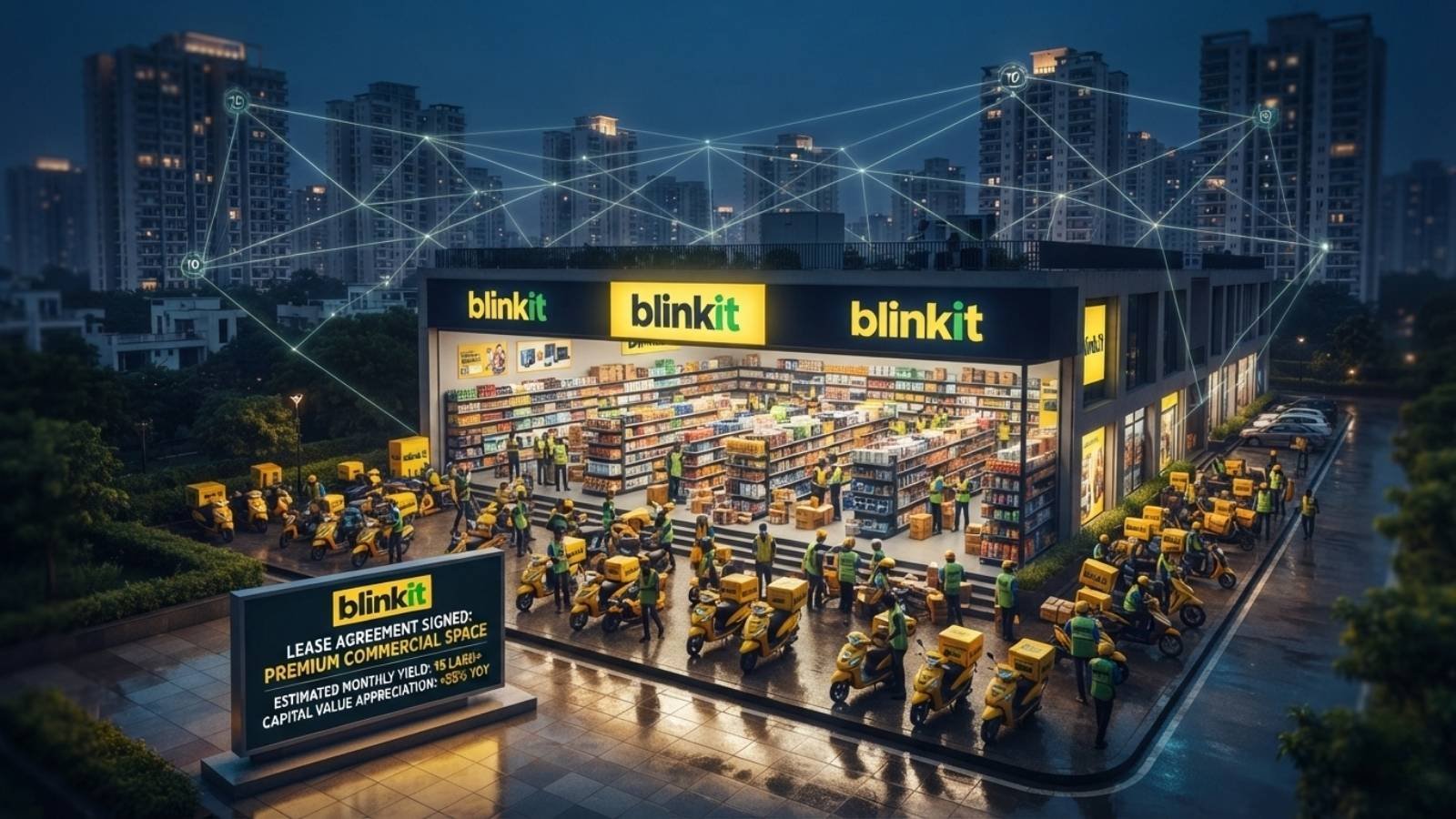
How Blinkit’s Dark Store Empire is Rewriting Gurugram’s Commercial Real Estate Prices
Zomato is no longer just a food tech giant; it has quietly become one of the most aggressive institutional tenants in Delhi-NCR’s commercial real estate sector. Driven by Albinder Dhindsa’s rapid expansion of Blinkit, the quick-commerce platform is systematically acquiring ground-floor and basement retail spaces across Gurugram. This hyper-local expansion is doing more than just enabling 10-minute grocery deliveries—it is single-handedly creating a micro-bubble in Gurugram’s commercial rental market, pushing lease yields to unprecedented highs.
While public attention remains fixated on Zomato CEO Deepinder Goyal’s massive ₹219 crore property empire and the staggering monthly maintenance bills at his DLF The Camellias sanctuary, the company’s backend infrastructure play is where the true, long-term wealth generation is occurring. Here is exactly how Blinkit’s dark store strategy is transforming the economics of Gurugram commercial real estate in 2026.
The 5,000 Sq Ft Micro-Warehouse Bubble
Unlike traditional e-commerce giants that rely on massive, million-square-foot fulfillment centers on the city’s outskirts, quick commerce requires a dense grid of fulfillment nodes embedded directly within premium neighborhoods. Furthermore, the nature of what Blinkit delivers has fundamentally changed. The era of the 2,000-square-foot dark store—built merely to stash milk, bread, and instant noodles—is dead.
To accommodate an explosive expansion into high-ticket SKUs, consumer electronics (like PlayStation 5s), beauty counters, and apparel, Blinkit’s algorithmic mapping now mandates a massive physical footprint, with industry reports from UBS indicating a shift toward facilities exceeding 5,000 square feet and ₹2.5 crore in capex. The company routinely targets properties offering 5,000 to 7,500 square feet of contiguous ground floor or basement space, pairing it with strict structural requirements: minimum 10-foot ceiling heights, heavy power loads (40+ KV) to run industrial cold rooms, and dedicated exterior staging zones capable of handling dozens of delivery riders and mid-sized supply trucks simultaneously.
Historically, securing institutional tenants for oversized basements, defunct banquet halls, or deep-set commercial real estate within residential sectors (such as Gurugram’s Sector 57, 66, 70, or the dense clusters along the Dwarka Expressway) was notoriously difficult for landlords. Today, these exact low-demand layouts are prime targets. By turning previously underutilized, “dead” commercial inventory into hyper-frequency logistics hubs, Blinkit has completely inverted the supply-and-demand curve in these micro-markets.
The Rental Surge: Let’s Do the Math
The influx of heavily funded quick-commerce players—with Zepto and Swiggy Instamart aggressively competing for the exact same geographic coordinates—has triggered a fierce bidding war for optimal dark store locations.
- The Baseline Shift: Ground floors and functional basements in emerging Gurugram sectors that previously struggled to command ₹1 Lakh to ₹1.5 Lakh per month are now seeing standard lease agreements signed at ₹3.5 Lakh to over ₹7 Lakh per month, depending on localized population density. Because digital order volume dictates their revenue rather than physical foot traffic, quick commerce platforms can easily out-bid traditional retail yields.
- The “Unicorn Tenant” Premium via FOCO: This real estate rush is further accelerated by the Franchise-Owned, Company-Operated (FOCO) model. Local High-Net-Worth Investors (HNIs) are aggressively putting up the ₹2 crore to ₹2.5 crore in initial capital expenditures to set up these massive stores, acting as the primary leaseholders. For property owners, leasing to these backed franchises guarantees stable, long-term corporate security, giving landlords the leverage to demand a 20% to 35% premium over standard market retail rates.
- Capital Value Appreciation: Because commercial property valuations are calculated as a direct multiple of their rental yields, adding ₹2 Lakh to ₹4 Lakh to a property’s monthly rent drastically inflates its overall capital value. This micro-bubble is generating massive, rapid wealth for local property owners who happened to hold the right physical layouts in the right zip codes.
The Infrastructure Monopoly and Urban Friction
Blinkit currently operates over 1,000 dark stores across India, commanding a significant plurality of the quick-commerce market share. However, the aggressive footprint expansion in Gurugram reveals Zomato’s broader corporate strategy: monopolizing the physical infrastructure required to operate in dense urban environments. Once Blinkit locks in a highly strategic neighborhood lease, it mathematically prevents competitors from securing an optimal distribution node in that exact radius.
However, this infrastructure empire is facing growing pains. By forcing intensive logistical hubs into mixed-use neighborhoods, Blinkit has triggered an immense zoning backlash. Resident Welfare Associations (RWAs) across Gurugram are actively fighting the severe fleet congestion, noise, and unauthorized commercial use of residential basements. As municipal authorities begin scrutinizing these localized permits, the sustainability of these hyper-inflated commercial yields will depend heavily on how well Zomato can navigate urban regulatory friction.
Yet, despite the logistical friction, this aggressive real estate land-grab justifies Zomato’s massive public market valuation and explains the staggering personal net worths of its leadership team. From capturing local weekend entertainment and ticketing via the District App to fundamentally altering commercial lease rates through Blinkit, Zomato is seamlessly integrating itself into the physical, cultural, and financial architecture of Delhi-NCR.
