
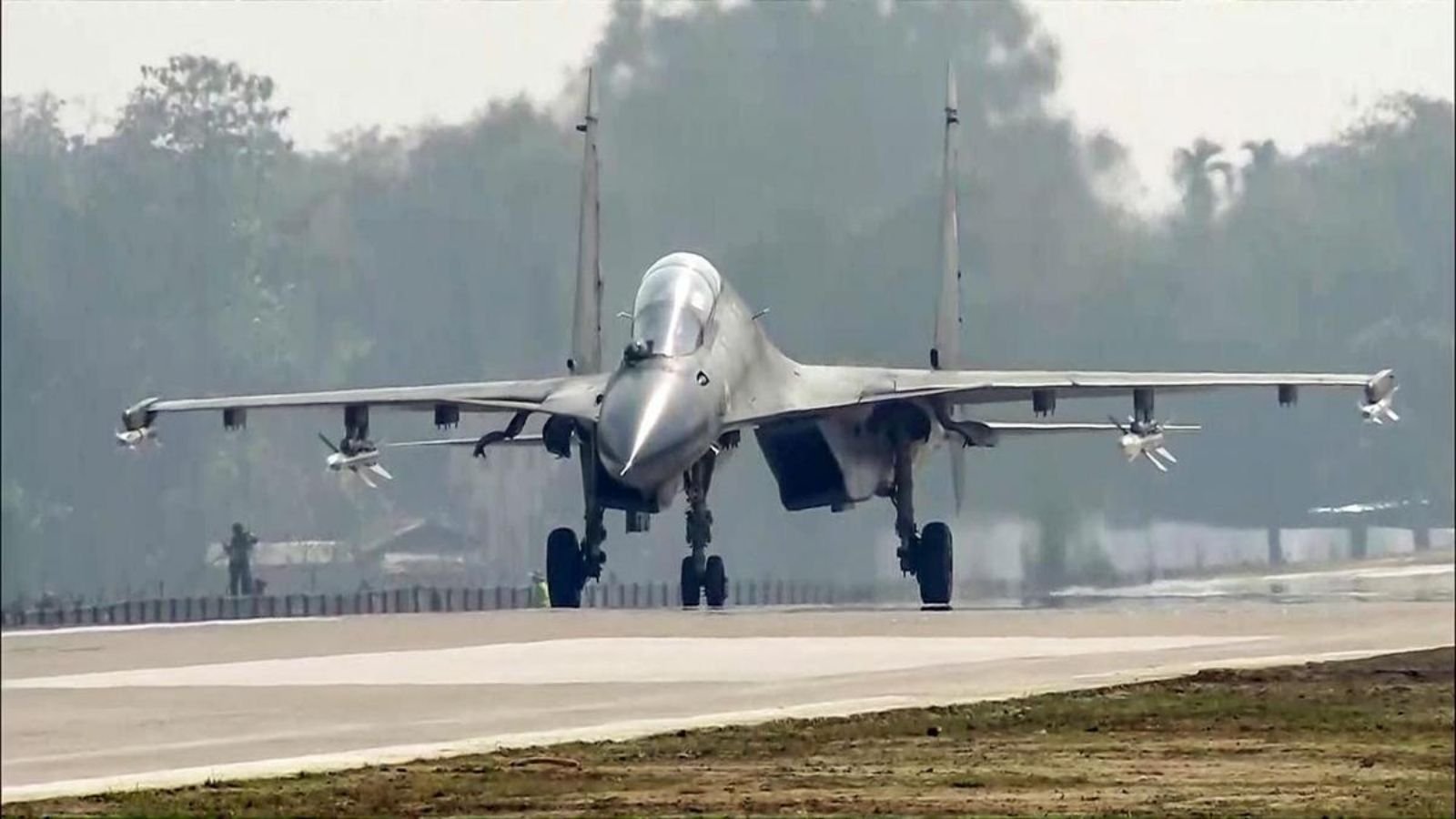
Russian Body, Desi Brain: How India is Turning the Su-30MKI into a Lethal Stealth Hunter
The Indian Air Force (IAF) is preparing for one of the most ambitious fighter aircraft modernizations in its history. Under the “Super Sukhoi” overhaul plan, India’s primary multi-role air superiority jet, the Sukhoi Su-30MKI, is undergoing a transformative upgrade. While the aircraft retains its combat-proven Russian airframe and thrust-vectoring maneuverability, its entire sensory and electronic core is being replaced with indigenous technology.
This “Desi brain” initiative seeks to elevate the twin-engine heavyweight fighter into an advanced 4.5+ generation combat platform capable of tracking stealth aircraft from stand-off distances. Led by domestic defense agencies, the overhaul reduces reliance on foreign supply chains while turning the backbone of India’s aerial force into a potent anti-stealth asset.
The Super Sukhoi Overhaul: Upgrading Radar and Avionics
The core of the Super Sukhoi program involves a phased modernization of an initial batch of 84 aircraft, with plans to systematically upgrade the broader fleet of over 260 Su-30MKIs. The program is being executed by Hindustan Aeronautics Limited (HAL) alongside private domestic suppliers. By integrating locally developed components, India aims to push the indigenous content of the Su-30MKI from roughly 50 percent to nearly 78 percent.
Central to this transformation is the replacement of the original Russian-made N011M Bars passive electronically scanned array (PESA) radar. In its place, engineers are integrating the indigenous Virupaksha radar—an upscaled variant of the Uttam Active Electronically Scanned Array (AESA) radar series. Built on Gallium Nitride (GaN) semiconductor technology, the Virupaksha unit provides significantly higher power output, sharper target resolution, and enhanced resistance to electronic attack.
Hunting Stealth Aircraft at Stand-Off Ranges
The introduction of the Virupaksha radar significantly expands the Su-30MKI’s situational awareness. While traditional radars struggle to track low-radar-cross-section (RCS) stealth aircraft, the new AESA system allows the Super Sukhoi to identify standard target aircraft at distances of 300 to 400 kilometers and detect stealthy 5th-generation fighters at ranges beyond 200 kilometers.
| System Capability | Original Su-30MKI | Upgraded Super Sukhoi |
| Primary Sensor | N011M Bars PESA Radar | Indigenous Virupaksha AESA Radar |
| Detection Range (Standard) | ~140 – 180 km | 300 – 400 km |
| Stealth Target Detection | Extremely Limited | Beyond 200 km (Low RCS aircraft) |
| Mission Processing Unit | Russian Avionics Computer | Indigenous High-Speed Mission Computer |
| Overall Local Content | ~50% – 60% | Up to 78% Indigenous Content |
| Primary BVR Weapons | R-77 & Early Astra Variants | Astra Mk-1/Mk-2, Rudram, Smart Munitions |
In addition to its search modes, the radar system can simultaneously track up to 100 aerial targets while engaging multiple threats. This sensor capability enables the Su-30MKI to serve as an airborne battle-management hub during complex multi-aircraft operations, complementing national defense initiatives aimed at securing sovereign airspace.
Indigenous Avionics and Electronic Warfare Capabilities
Beyond the radar overhaul, the Super Sukhoi initiative updates the aircraft’s entire electronic architecture. The original mission computer is being replaced by a high-speed Indian processing unit designed to handle complex data fusion, digital map displays, and real-time threat analysis without external software restrictions.
Complementing the mission computer is an advanced digital electronic warfare (EW) suite developed by the Defence Research and Development Organisation. The EW suite incorporates digital radio frequency memory (DRFM) jammers and a modern radar warning receiver, enabling the aircraft to blind enemy radar installations while protecting itself against incoming missiles. These breakthroughs reflect broader achievements in advanced technological engineering being pioneered across national research institutions.
Weapons Integration and Fleet Sustainability
The modernization allows the IAF to equip the Su-30MKI with a complete arsenal of domestically manufactured weapons. The upgraded fighter will deploy the Astra Mark-1 and extended-range Astra Mark-2 beyond-visual-range air-to-air missiles, alongside the Rudram series of anti-radiation missiles and precision-guided anti-airfield weapons.
With the initial phase awaiting final execution clearance from the Cabinet Committee on Security, the Super Sukhoi program ensures the IAF’s primary heavy fighter remains formidable well into the 2040s. Much like India’s success with indigenous air defense platforms, upgrading existing frontline fighters with domestic electronic brains presents a sustainable blueprint for regional air superiority.
