
Beyond the Card: How the eShram Portal is Reshaping Social Security for Delhi-NCR’s Informal Workforce
Behind every multi-crore real estate deal in Sector 63A and every sprawling pop-up festival at Pragati Maidan lies an invisible, relentless engine: the urban informal workforce. From gig-economy delivery riders navigating Delhi’s chaotic arteries to the construction laborers building Gurugram’s next luxury high-rises, unorganized workers form the absolute backbone of the National Capital Region (NCR).
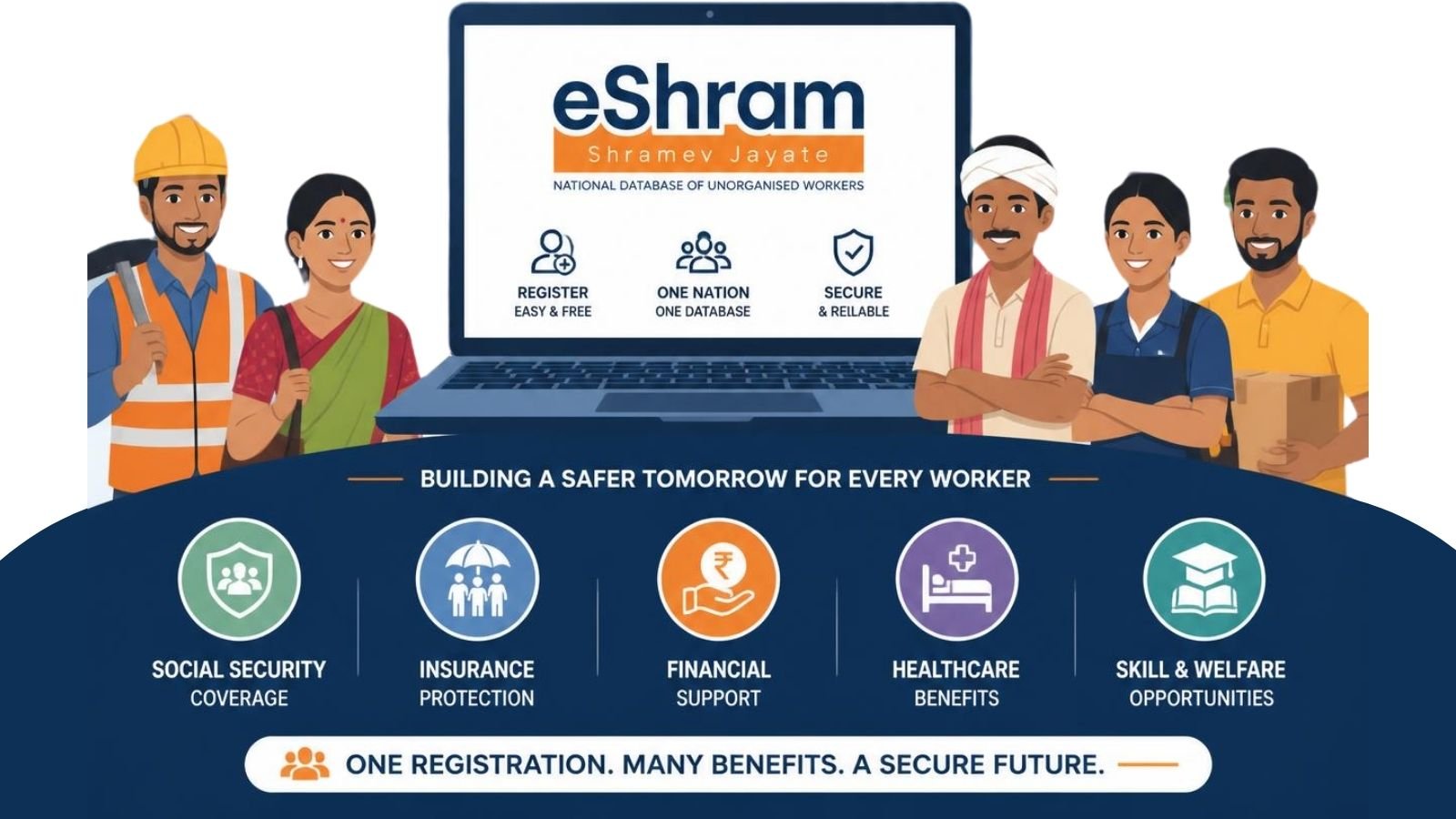
Yet, for decades, this demographic operated almost entirely outside the formal social security net. That paradigm shifted dramatically with the launch of the Ministry of Labour and Employment’s eShram Portal in 2021. Marking its fifth anniversary in August 2026 with a monumental 31.89 crore registrations nationwide, the eShram Card has evolved from a simple identity registry into a sophisticated, unified policy tool. Today, it centralizes welfare delivery, insurance, skill mapping, and pensions under a single digital roof.
For policymakers, urban planners, and the workforce itself, the platform is an unprecedented administrative experiment. Here is a deep-dive analysis of how the eShram scheme is actively bridging the gap between NCR’s unorganized sector and formal government safety nets.
eShram Card 2026: Essential Facts at a Glance
- What is it? A free, Aadhaar-seeded national database providing a unique 12-digit Universal Account Number (UAN) to India’s unorganized workers.
- Primary eShram Card Benefits: Free ₹2 Lakh accidental insurance (via PMSBY), access to a ₹3,000 monthly pension (via PM-SYM), and immediate Direct Benefit Transfers (DBT) during crises.
- Who can apply? Any unorganized sector worker aged 16–59 who is not a member of EPFO/ESIC.
- Registration: 100% free via the official portal (
register.eshram.gov.in) or assisted through Common Service Centres (CSCs).
eShram Registration Eligibility: Who Qualifies in the Urban Economy?
The brilliance—and the primary administrative challenge—of the eShram database is its vast, inclusive scope. The portal officially classifies hundreds of occupations under the unorganized sector. However, in a hyper-urbanized environment like Delhi-NCR, this demographic looks vastly different than in rural hinterlands.
The Urban Gig and Service Economy While agricultural labor makes up a massive chunk of national data, NCR’s numbers are heavily driven by the modern service and gig economies. eShram Registration Eligibility specifically encompasses:
- Platform & Gig Workers: Ride-sharing drivers, food delivery agents, and rapid-commerce logistics couriers.
- Construction & Infrastructure: Migrant laborers, painters, plumbers, and electricians constructing the region’s expanding transit corridors and premium corporate hubs.
- Domestic & Street Service: Domestic helpers, security guards, street vendors, and auto-rickshaw drivers.
To qualify, an applicant must simply be between 16 and 59 years old, possess a mobile number linked to their Aadhaar, maintain an active bank account, and crucially, not be a contributing member of formal corporate safety nets like the Employees’ Provident Fund Organization (EPFO) or Employees’ State Insurance Corporation (ESIC).
Decoding eShram Card Benefits for NCR’s Workforce
Why should a daily wage earner in Noida or a delivery partner in South Delhi care about securing yet another government ID? The answer lies in the tangible financial safety nets the 12-digit UAN instantly unlocks.
1. Immediate Financial Security (Accidental Insurance)
The chaotic traffic and high-risk environments of NCR make gig and construction work inherently dangerous. One of the most vital eShram Card Benefits is its automatic integration with the Pradhan Mantri Suraksha Bima Yojana (PMSBY). Registered workers are eligible for an accidental insurance cover of ₹2 Lakh for accidental death or permanent disability, and ₹1 Lakh for partial disability. For families living strictly on daily wages, this policy prevents a sudden occupational accident from turning into an irreversible financial catastrophe.
2. Long-Term Survival: The PM-SYM Pension
Informal workers rarely have the luxury of mutual funds or retirement corpus planning. The eShram portal directly funnels eligible workers (aged 18–40) into the Pradhan Mantri Shram Yogi Maan-dhan (PM-SYM) scheme. This guarantees a minimum assured pension of ₹3,000 per month upon reaching the age of 60, offering a much-needed baseline of financial dignity in old age.
3. Direct Benefit Transfers (DBT) during Crises
During emergency lockdowns or localized crises, governments historically struggled to distribute aid because informal workers lacked a unified, verified database. The Aadhaar-seeded eShram system lets state governments bypass bureaucratic red tape and route emergency financial assistance directly into verified workers’ bank accounts through Direct Benefit Transfer (DBT) mechanisms.
The Administrative Challenge: How Informal Workers Access Unorganized Sector Schemes
Creating a high-tech portal is merely step one; executing it on the ground is the true test of governance. As highlighted in our recent analysis on why India is losing efficient bureaucrats like Divya Mittal, well-intentioned national policies often bottleneck at the district level due to execution fatigue and administrative bloat.
Navigating the Migrant Reality The biggest administrative hurdle in Delhi-NCR is the transient nature of the workforce. A construction worker might possess an Aadhaar card from Bihar but currently work on a site in Gurugram. The eShram UAN is designed to be fully portable across state lines, allowing migrant laborers to access welfare regardless of their shifting geographical location.
However, district magistrates and labor commissioners in NCR face continuous challenges with digital literacy. While the official process is entirely paperless and based on Aadhaar e-KYC, many workers struggle with mobile-linkage issues. Proactive local governance is required to set up Common Service Centres (CSCs) near massive construction hubs and slum clusters to facilitate assisted registrations.
As former Secretary Anil Swarup noted in his exclusive interview with The Optimist News, “honesty alone isn’t enough; a civil servant must make things happen on the ground.” For eShram to fulfill its mandate, making it happen means active outreach—setting up mobile registration camps precisely where the workforce congregates.
The One-Stop Solution: Evolving Beyond Identity
As of late 2026, the eShram portal is no longer just a static database; it has transformed into a dynamic “One-Stop Solution” integrating welfare, employment, and skilling.
- Job Linkages: The platform now connects directly with the National Career Service (NCS) portal, allowing verified workers to find localized employment opportunities suited to their registered skill sets.
- Skill India Integration: By interfacing with the Skill India Digital Hub, eShram registrants can access upskilling and apprenticeship programs. This allows a daily-wage laborer to transition out of informal labor and into certified, higher-paying trades.
Shaping the Future of Urban Labor
The success of the eShram initiative across Delhi-NCR is more than a statistical bureaucratic milestone; it represents a fundamental shift in how the state views its most vulnerable citizens. By converting untracked, invisible labor into verified, protected data points, the government can finally design better transit, housing, and healthcare infrastructure tailored to actual workforce demographics.
For the millions of workers powering the aesthetic and economic rise of the capital region, the eShram card offers something previously unimaginable in the informal sector: an officially recognized identity backed by a tangible, digital safety net.
Have you noticed local eShram registration camps for gig workers or support staff in your corporate sector or residential society? Let us know how your local administration is executing this vital social security scheme!
