
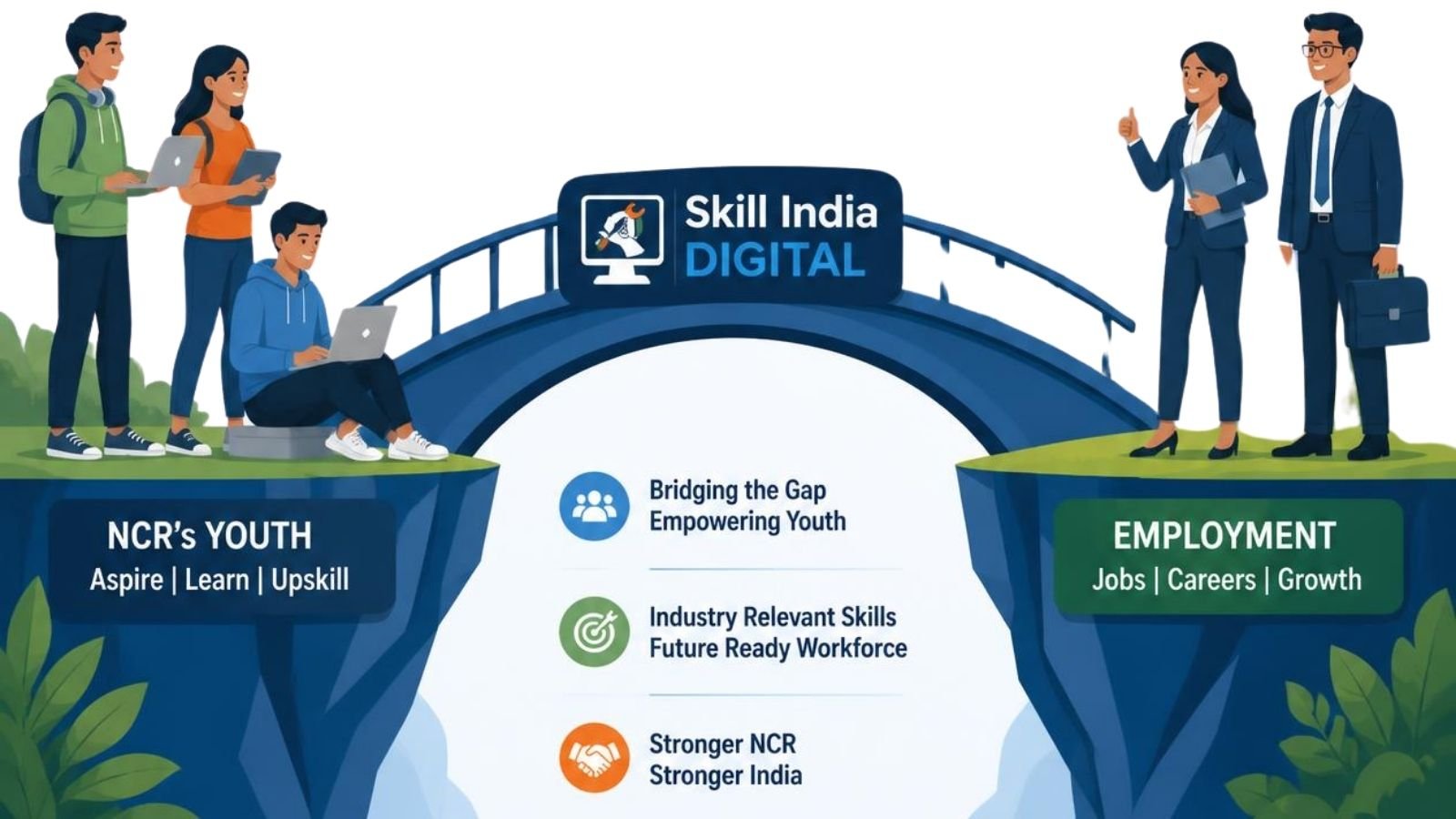
From Classrooms to Corporate Towers: How Skill India Digital is Bridging NCR’s Youth Employability Gap
The Delhi-NCR skyline tells a story of relentless economic ambition. From the multi-crore transactions defining the ultra-luxury real estate corridors of Sector 63A to the sprawling, high-tech beauty hangars of events like Nykaaland 4.0, the region is a magnet for capital and innovation. However, beneath the polished glass facades of Gurugram and Noida’s corporate parks, HR executives and tech leaders have long faced a structural paradox: millions of young graduates are desperately searching for jobs, yet companies are equally desperate to find employable talent.
For years, the Indian education system produced degrees, but not necessarily skills. Enter the government’s latest, hyper-focused intervention: the Skill India Digital Hub (SIDH) and the ambitious Pradhan Mantri Kaushal Vikas Yojana (PMKVY 4.0).
As we cross the halfway mark of 2026, PMKVY 4.0 has evolved far beyond its original scope. By partnering directly with industry leaders and pivoting toward “Industry 4.0” competencies, the national skill mission is quietly engineering a massive workforce upgrade. Here is how these initiatives are actively bridging the employability gap across Delhi-NCR.
The Evolution: PMKVY 4.0 and the Skill India Digital Hub
Historically, government skilling schemes were fragmented. A youth seeking vocational training in Delhi had to navigate a maze of disconnected portals. Today, the Skill India Digital Hub serves as a centralized, Aadhaar-linked digital ecosystem. It unifies everything—course discovery, biometric attendance, digital assessments, and job matching—into one seamless mobile experience.
What Makes PMKVY 4.0 Different?
Under the purview of the Ministry of Skill Development and Entrepreneurship (MSDE), PMKVY 4.0 shifts the focus entirely toward outcome-based, industry-relevant training. For job-seekers aged 15 to 45, the program offers:
- Zero-Cost Training: 100% free tuition across 38 high-growth sectors, completely removing financial barriers.
- NSQF-Aligned Certification: Government-validated credentials under the National Skills Qualification Framework (NSQF).
- Mandatory On-the-Job Training (OJT): Moving away from purely theoretical classroom learning, the scheme now mandates up to 70% practical, in-industry work exposure.
Navigating the Portal For youth across Delhi-NCR, accessing these resources is straightforward. A quick Skill India Digital Portal login using an Aadhaar-linked mobile number unlocks thousands of short-term training (STT) programs and Recognition of Prior Learning (RPL) opportunities designed to formalize existing experiential skills.
Beyond Data Entry: Upskilling for Industry 4.0
The most significant transformation in the 2026 PMKVY curriculum is its pivot toward the future. While traditional trades like construction and hospitality remain essential, the curriculum has aggressively expanded to include over 600 futuristic job roles.
For the corporate hubs of Gurugram and Noida, this is a game-changer. The Skill Development Training Centers in Delhi NCR are now equipping youth with capabilities that directly match local corporate hiring demands:
- Deep Tech & IT: Artificial Intelligence (AI), Robotics, Internet of Things (IoT), Cybersecurity, and Data Analytics.
- Green Jobs: Solar photovoltaic installation, EV (Electric Vehicle) servicing, and Agri-Drone operations.
- Advanced Manufacturing: Semiconductor tech and 3D printing.
By aligning government training with the actual technological needs of multinational corporations, the state is ensuring that a certificate translates directly into a paycheck.
Corporate Synergies and Grassroots Execution
The success of the Skill India mission in a metro environment relies heavily on Corporate Social Responsibility (CSR) and proactive district governance. Through frameworks like the CII Rahul Bajaj Centre of Excellence on Skills, industry heavyweights (including HCL, IBM, and Microsoft) are stepping in as awarding bodies. They are helping design the curriculum, ensuring that the training delivered in an Okhla or Faridabad Skill Hub meets the rigorous standards of a global tech firm.
However, the execution of this massive policy vision requires exceptional bureaucratic leadership on the ground. As we noted in our recent analysis on why India is losing its best bureaucrats like IAS Divya Mittal, transformative policies often bottleneck at the district level if not driven by dedicated officers. Establishing model career centers, auditing affiliated institutes, and preventing fraudulent “certificate mills” requires the kind of uncompromising administrative stamina that former Secretary Anil Swarup consistently advocates for.
The Next Step: Transitioning the Informal Workforce
The overarching genius of India’s current policy ecosystem is how its digital platforms interact. The Skill India initiative does not exist in a vacuum; it acts as the essential “next step” for vulnerable populations mapped by other government networks.
Consider the millions of gig workers, domestic staff, and construction laborers recently documented on the national registry. As we explored in our deep-dive on how the eShram Portal is reshaping social security for Delhi-NCR’s informal workforce, basic survival and identity verification are now covered. But how does a daily-wage laborer escape the cycle of the informal economy?
By linking eShram databases with the Skill India Digital Hub, the government is creating a direct pathway for upward mobility. A registered construction worker can utilize the Recognition of Prior Learning (RPL) component to gain formal certification for their trade, eventually upskilling to operate advanced heavy machinery or oversee site logistics, thereby moving from an unorganized daily wage to a formal corporate payroll.
A Skilled Future for Delhi-NCR
The gap between classrooms and corporate towers is finally closing. By integrating AI-driven digital platforms with stringent industry standards and zero-cost training, PMKVY 4.0 is turning India’s demographic dividend from a talking point into a tangible economic asset.
For the youth of Delhi-NCR—whether they are stepping out of a rural school in Haryana or seeking to transition out of a low-paying BPO job in Noida—the Skill India Digital Hub is proving that with the right alignment of policy and corporate intent, world-class employability is just a login away.
