
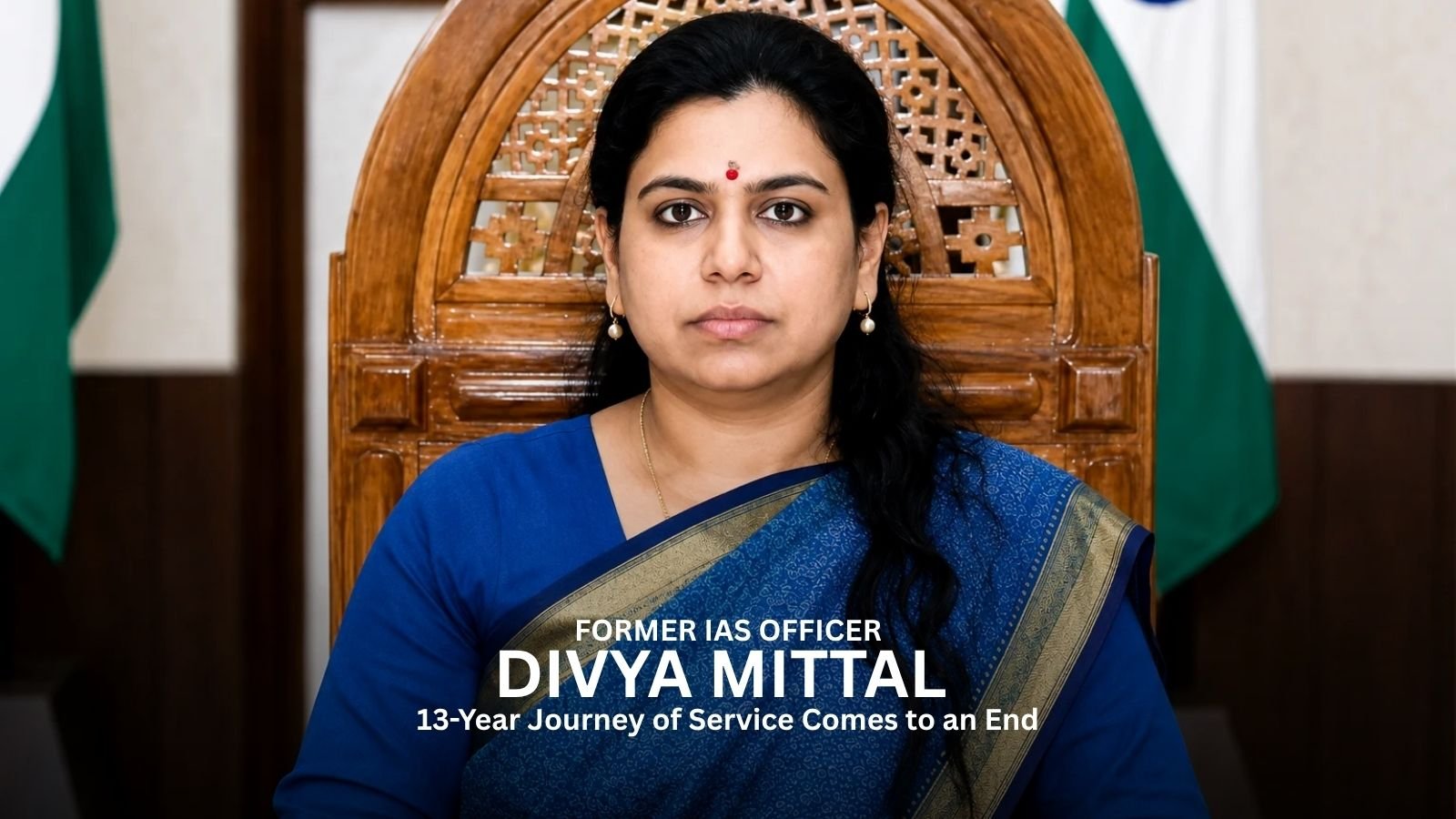
IAS Divya Mittal Resigns: Why India is Losing its Best Bureaucrats
When an honest, high-performing civil servant quietly exits the system, it is rarely just a personal career shift; it is a structural distress signal. On September 15, 2026, the Department of Personnel and Training (DoPT) officially accepted the voluntary resignation of 2013-batch UP Cadre Indian Administrative Service (IAS) officer Divya Mittal. After 13 years of service, her departure has sparked intense discussions across policy circles and social media, highlighting the immense friction faced by result-oriented bureaucrats in India.
The news immediately caught the attention of Anil Swarup, former Secretary to the Government of India and author of Not Just a Civil Servant. Taking to LinkedIn to address the resignation, Swarup delivered a stark warning to the establishment.
“1952. What Chanakya didn’t say,” Swarup wrote. “We need to nurture honest and efficient officers because they attempt to perform in a difficult set of circumstances. If they keep quitting, we will be left with dishonest non-performers. #chanakyadidntsay”
Swarup’s observation perfectly encapsulates a growing crisis in Indian governance. As The Optimist News recently explored in an exclusive interview with Mr. Swarup, absolute honesty is merely a starting point—a civil servant must have the environment to actually “make things happen on the ground.” But what happens when the officers who make things happen simply walk away?
The Reverse Brain Drain: From London to Lahuria Dah
Divya Mittal’s trajectory into the civil service was the quintessential “reverse brain drain” story that UPSC aspirants idolize. Originally from Rewari, Haryana, she built an elite academic foundation, earning a B.Tech in Engineering Physics from IIT Delhi and a PGDM from IIM Bangalore.
Following her MBA, Mittal relocated to London, securing a highly lucrative role as an exotic derivatives trader at JP Morgan. Yet, despite the financial success, she felt a profound “debt” to her country. Leaving the corporate world behind, she returned to India, cracked the UPSC examinations, and joined the UP cadre in 2013.
Unlike many who succumb to bureaucratic inertia, Mittal earned a reputation as a fierce, ground-level operator. She served as the Chief Development Officer (CDO) in Gonda and later took charge as the District Magistrate (DM) for Sant Kabir Nagar, Mirzapur, and Deoria.
Her defining legacy was cemented in Mirzapur. For 75 years since India’s independence, the semi-arid, remote hill village of Lahuria Dah had suffered from an acute water crisis, relying entirely on erratic tankers and a single broken well. During her tenure as DM, Mittal relentlessly pursued the infrastructure project, finally bringing piped water directly to 125 households in the village in August 2023.
In her emotional farewell post on X (formerly Twitter), Mittal recalled the defining moment of her career: “An elderly mother from the hills of Lahuria Dah, who didn’t say a word when she saw water reaching her village for the first time, just touched my head with trembling hands and blessed me. The post has been left today, but that touch will not leave me for the rest of my life.”
“Honesty Alone Isn’t Enough”: The Anil Swarup Warning
The resignation of officers like Mittal validates Anil Swarup’s long-standing critique of the Indian administrative framework. In his recent conversation with The Optimist News, Swarup emphasized that bureaucracy must protect its performers from politicization.
While Mittal cited “personal reasons, family priorities, and new life goals” in her resignation letter, administrative insiders point to the friction she allegedly faced. In May 2026, she was abruptly transferred from her active role as Deoria DM to a relatively less prominent position as Special Secretary in the Revenue Department. Such sudden, seemingly punitive transfers of high-performing officers often serve as the tipping point for mid-career bureaucrats who joined the service to execute systemic change, not manage desk files.
Swarup’s LinkedIn post underscores a dangerous systemic vulnerability. If the administrative ecosystem actively exhausts its most driven officers, the vacuum will inevitably be filled by those willing to compromise, leading to a governance structure dominated by “dishonest non-performers.”
A Systemic Crisis in Indian Bureaucracy?
Divya Mittal’s exit is not an isolated incident; it is part of a quiet, mid-career exodus of top-tier talent. Over the last few years, several high-profile, IIT/IIM-educated bureaucrats have opted for voluntary retirement or resigned to enter the private sector, public policy, or entrepreneurship. Today’s civil servants are highly skilled professionals who recognize that the IAS is no longer the sole avenue to enact societal change.
However, the system still boasts remarkable individuals fighting against the current. The nation continues to benefit from visionary officers who refuse to back down in the face of structural hurdles. From IFS officer Sudha Ramen’s relentless environmental crusades, to the community-driven policing models pioneered by Bihar IPS officer Vikas Vaibhav, and the boundary-breaking leadership of Aparajita Rai, Sikkim’s first female IPS officer, the core of Indian bureaucracy is still held together by exceptional talent.
The pressing question is: How long can the system rely on individual resilience without offering institutional support?
The Bureaucratic Bottleneck: Red Tape vs. Ground Reality
The friction that exhausts dynamic officers often stems from the very structure of daily governance. Anil Swarup has long maintained that performance on the ground is the true metric of a civil servant, a philosophy that starkly contrasts with the reality of modern administration, which is frequently bogged down by administrative bloat.
Interestingly, this systemic exhaustion is now being acknowledged at the highest levels. In a recent push for faster governance, the Centre issued strict directives asking civil servants to cut out “unnecessary and endless meetings.” As highlighted in recent administrative circulars, officers have been instructed to follow clear agendas, avoid delays, and ensure proper follow-ups rather than getting trapped in endless boardroom discussions.
For officers like Divya Mittal, who measure their success by physical pipelines laid and remote villages hydrated—being pulled from active, ground-level execution into a vortex of secretariat meetings or desk-bound roles is deeply demoralizing. The Centre’s directive to cut meeting bloat validates the exact frustration that drives efficient officers to reconsider their tenure in the IAS. If the government wants to retain its top performers, aligning daily governance with actual ground execution, rather than endless deliberation, is the necessary first step.
What Lies Ahead for Divya Mittal
As she officially stepped down on September 15, 2026, Mittal posted a cryptic yet powerful quote from poet Jaishankar Prasad on her X account: “Prashast punya panth hai, badhe chalo, badhe chalo” (The path of virtue is wide; keep moving forward).
While her official mandate has ended, she made it clear that her dedication to the country remains intact. “Even though I had everything in London, something was missing. Not being in my country bothered me,” she reflected in her statement. While rumors swirl regarding a potential entry into politics or public policy, one thing is certain: Divya Mittal’s desire to create an impact has not wavered.
But as Anil Swarup rightfully highlighted, her departure is a profound loss for the Indian Administrative Service. If the nation wishes to retain its brightest minds to lead its districts, policies, and future, the bureaucratic ecosystem must urgently learn to nurture, rather than neutralize, its most effective officers.
