
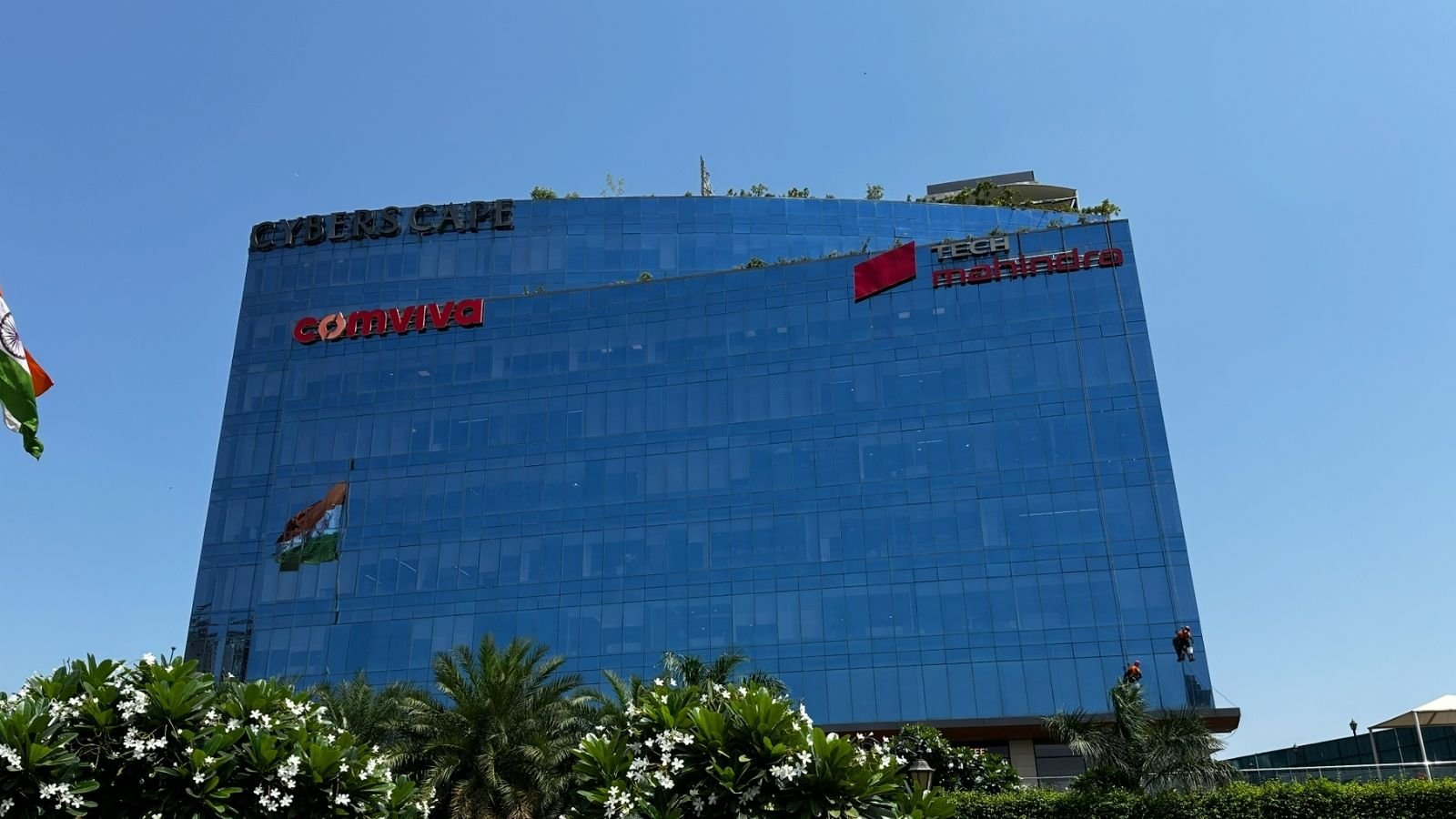
Hanging by a Thread at 200 Feet: The Invisible Human Engine Behind Gurugram’s Glass Skyline
GURUGRAM — Behind every gleaming corporate tower along Golf Course Extension Road is a quiet, high-stakes story of human endurance.
While the Millennium City celebrates its booming tech ecosystems, multi-crore real estate launches, and ultra-luxury residential corridors, we rarely stop to look up at the sheer physical grit required to keep these modern architectural monuments shining.
On a warm afternoon outside the Capital Cyberscape building in Sector 59—the massive, glass-fronted commercial complex housing corporate occupiers like Tech Mahindra and Comviva—a striking scene unfolds against the blue sky. Suspended hundreds of feet above the asphalt, a team of facade cleaners executes a daily, death-defying routine.
There are no air-conditioned corner offices for these men. There are no ergonomic chairs or automated platforms. Armed with a bucket of neutral detergent, a heavy-duty squeegee, industrial-grade harnesses, and incredible nerve, they scale the sheer vertical drop of Gurugram’s corporate skyline, hanging suspended between gravity and glass.
The Precision and Physics of High-Rise Rope Access
To the casual commuter driving down Golf Course Extension Road, these workers look like silent acrobats. In the industrial maintenance world, however, their work is known as Industrial Rope Access—a specialized discipline requiring rigorous safety protocols and immense physical conditioning.
Modern glass towers like Capital Cyberscape are designed with sleek, unbroken glass curtains that lack traditional built-in window cleaning cradles or mechanical building maintenance units (BMUs). To clean these sprawling, non-vertical, or flush architectural surfaces, facility management teams rely on certified rope access technicians.
Following strict international frameworks—such as those set by the IRATA (International Industrial Rope Access Trade Association)—these technicians never rely on a single rope. Every cleaner operates on a dual-line system anchored to heavy-duty roof parapet rigs:
- The Working Line: A high-tensile static rope that supports the technician’s weight and allows controlled descent using specialized descender devices.
- The Safety Line (Back-up): A secondary independent rope equipped with an automatic fall-arrest mechanism designed to lock instantaneously if the main line suffers friction wear or anchor failure.
Equipped with padded sit-harnesses, suction cups to anchor their bodies against sudden gusts of wind, and heavy chest ascenders, these men maneuver horizontally and vertically across smooth glass. Every movement requires intense core stability. A single drop of water on a smooth glass panel can render a footrest slick, making spatial awareness and body balance a matter of life and death.
Battling Gurugram’s Harsh Micro-Climate and Smog
The physical challenge of high-rise cleaning is compounded by the brutal weather cycles of Delhi-NCR. Facade cleaners work directly in the elements, exposed to extreme micro-climates created by the city’s high-density concrete and glass architecture.
- Blistering Thermal Glare (Summer): During Gurugram’s scorching summer months, when ambient temperatures cross 45°C, reflective double-glazed Low-E glass panels act as giant thermal amplifiers. The surface temperature of the glass can easily exceed 60°C, sending waves of radiant heat directly into the face of the technician hanging just inches away.
- Toxic Particulate & Winter Smog: During the post-monsoon and winter months, when Delhi-NCR’s Air Quality Index (AQI) frequently climbs into the “Severe” and “Hazardous” categories, high-rise facades bear the brunt of atmospheric pollution. A dense cocktail of PM2.5, PM10, vehicular exhaust, and construction dust coats the glass in a greasy, carbonaceous film. Cleaning this residue requires aggressive manual squeegeeing and specialized non-abrasive cleaning agents to prevent micro-scratches on modern solar-control coatings.
- Monsoon Calcification: The rainy season brings its own nightmare: mineral calcification. Rainwater combining with atmospheric dust leaves stubborn hard-water stains that bake into the glass under the sun, forcing technicians to painstakingly scrub individual panes by hand while battling unpredictable wind shear at higher elevations.
The Dual Realities of Golf Course Extension Road
The visual metaphor playing out on the facade of Capital Cyberscape is impossible to ignore. It captures the dual reality of Gurugram’s rapid urban expansion.
Inside these reflective glass walls, boardrooms are quiet and climate-controlled. Executives and software engineers debate quarterly revenue projections, AI integrations, and cross-border expansion roadmaps over fresh coffee. Yet, the literal transparency and prestige of those boardrooms depend entirely on the workforce hanging on the outside.
As Gurugram’s real estate footprint pushes further south—stretching from the established tech hubs of Sector 59 to the rapidly developing multi-crore ultra-luxury residential towers of Sector 63A and Sector 65—the demand for professional facade maintenance has grown exponentially. Millions of square feet of architectural glass are added to the city’s skyline every year, driving an unceasing need for skilled rope access teams.
While real estate brochures advertise “panoramic floor-to-ceiling glass views,” it is this unsung contractual workforce that ensures those views remain unobstructed. They bridge the gap between abstract architectural ambition and real-world physical upkeep.
A Grounding Perspective for the Millennium City
In a city that moves at breakneck speed—where conversations often revolve around the latest tech launches, startup valuations, and infrastructure upgrades—this quiet scene in Sector 59 offers a much-needed grounding moment.
The safety and dignity of these high-rise workers remain a vital conversation for the facility management industry. Ensuring strict adherence to safety standards, fair wages, thermal stress breaks during extreme summer days, and comprehensive medical insurance is essential for a workforce operating in one of the city’s most hazardous trades.
The next time you drive down Golf Course Extension Road, look past the gleaming corporate logos and take a moment to look up at the reflective glass. Beyond the glare, suspended against the sky, are the modern-day Spidermen—the invisible pulse of Gurugram, working tirelessly at 200 feet to ensure our city’s skyline always reflects progress.
Share Your Stories with The Optimist News
Have an original photo, an unsung human interest story, or a unique perspective on life and governance in Delhi-NCR? Connect with our editorial team at editor@theoptimist.news.
