
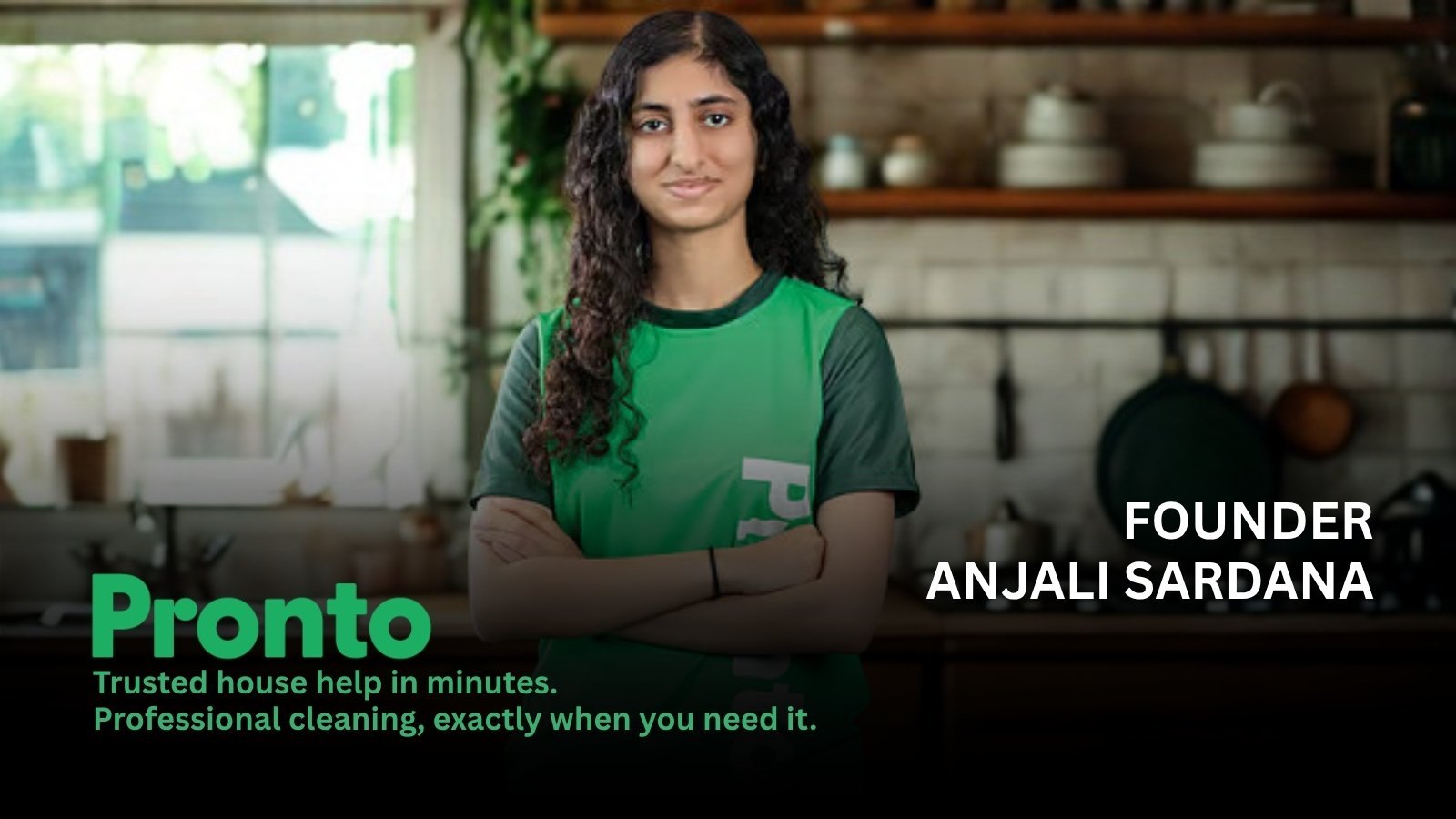
Anjali Sardana’s Pronto: The $200M Gurugram Startup Disrupting Domestic Help
In the sprawling high-rises of Gurugram, domestic help is the unspoken backbone of daily life. For decades, the sector has remained deeply informal, operating entirely on word-of-mouth recommendations, cash payments, and unregulated employment terms.
Enter Pron to, an on-demand, real-time household help platform that has taken the National Capital Region by storm. Launched in April 2025 out of a single hub in Sector 56, Gurugram, the platform promises 10-minute domestic services like cleaning, dishwashing, and laundry.
Behind this hyper-growth juggernaut is Anjali Sardana, an Indian-American entrepreneur who scaled the company to a staggering $200 million (over ₹1,600 crore) valuation in just over a year. But as the startup rapidly expands from 375 to over 45,700 daily bookings, the transition from elite vision to ground-level execution is sparking massive socio-economic debates.
Here is the complete inside look at Pronto’s rise, its ambitious AI integration, and the hidden growing pains of formalizing India’s oldest gig economy.
From Georgetown to Gurugram Ground Logistics
Anjali Sardana’s path to the dust and heat of Gurugram logistics is highly unconventional. Raised in a Punjabi family in the United States, she comes from an elite entrepreneurial pedigree—her father is an IIT-Delhi alumnus and entrepreneur, her mother is a physician, and her uncle is Raj Sardana, the founder of Innova Solutions.
Graduating at the top of her biology class from Georgetown University in 2024, Sardana briefly navigated the upper echelons of venture capital, securing roles at 8VC and Bain Capital. Yet, during her senior year, she became obsessed with a single problem: organizing India’s highly fragmented domestic workforce.
The velocity of her pivot is staggering. Within months of graduating in 2024, she left the comforts of US venture capital to manage blue-collar logistics in India. By April 2025, she launched Pronto, and by mid-2026, at just 23 years old, she had built a ₹1,600 crore empire.
Similar to how we have seen IPS officer Vikas Vaibhav channel systemic discipline into civic duty, Sardana channeled operational discipline into a socio-economic mission. Her goal was not just to build a convenient app for affluent homeowners, but to transition informal gig work into structured employment offering worker dignity, income stability, and financial identity.
The Valuation Explosion: $60 Million in a Year
Pronto’s growth metrics are historic. What began as a scrappy 170-booking-a-day operation has exploded into a 122x Year-over-Year growth phenomenon.
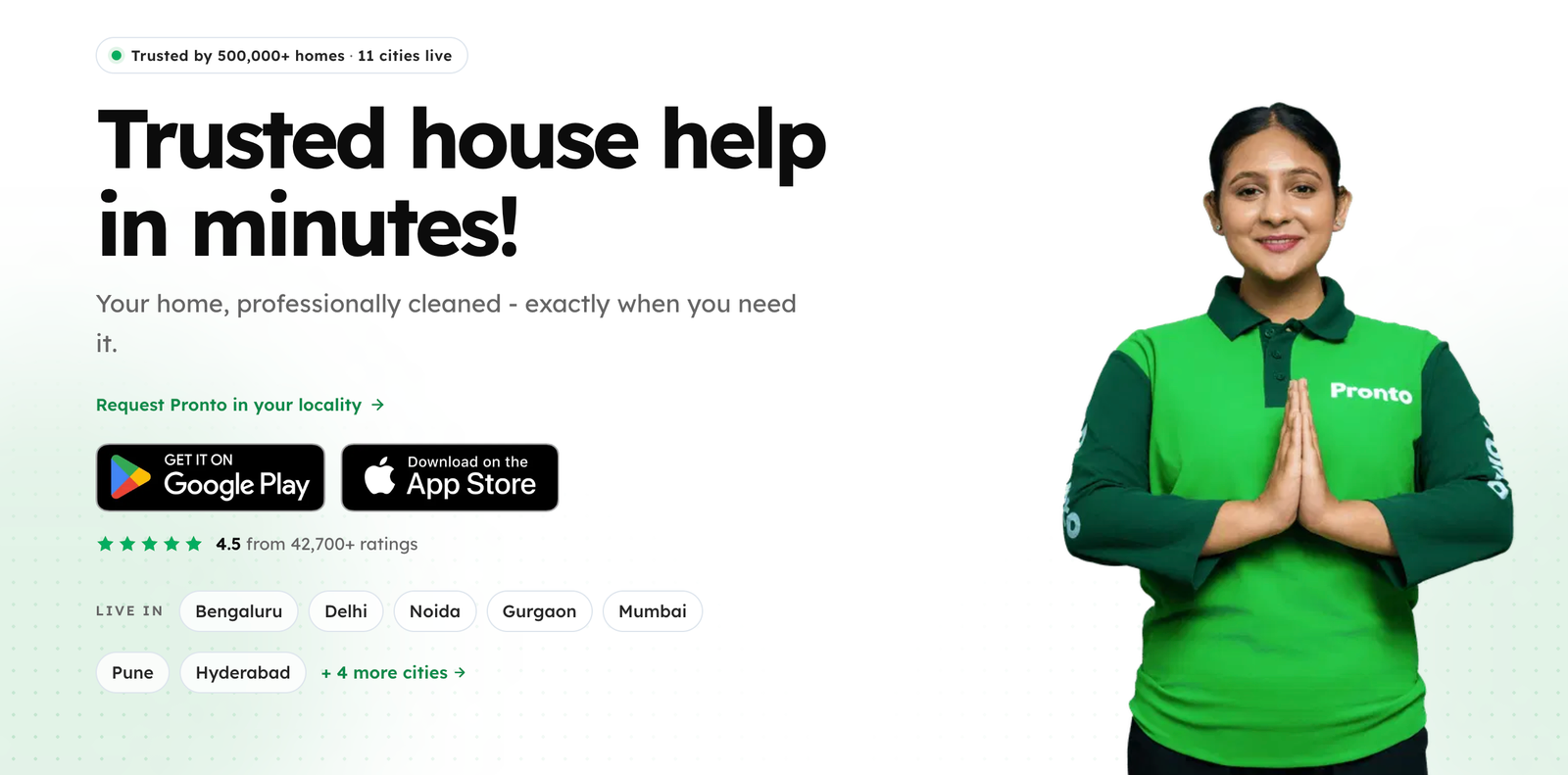
To fuel this, Sardana successfully courted some of the world’s most prominent investors. As of September 2026, Pronto has raised approximately $60 million.
- Early Rounds: An $11 million Series A in August 2025 set the foundation.
- Series B (March 2026): Secured $25 million led by Epiq Capital at a $100 million valuation.
- Series B Extension (May 2026): An additional $20 million injection led by US tech investor Lachy Groom, doubling the company’s valuation to $200 million.
The cap table now boasts heavyweights like General Catalyst, Bain Capital Ventures, and Glade Brook Capital. This mirrors the incredible scale we recently reported regarding Ghazal Alagh’s ₹10,000 crore Mamaearth empire, proving that Gurugram has officially become India’s primary incubator for record-breaking D2C and service startups.
“Pronto Verified” and the AI Value Chain
While the baseline service is impressive, Sardana recently announced Pronto’s most controversial and ambitious chapter yet: integrating India’s working class into the global Artificial Intelligence boom.
Noting that trillions of dollars flow into AI without benefiting blue-collar workers in the Global South, Pronto launched “Pronto Verified.”
- How it works: Customers can opt-in and pay a premium for a “Verified” booking. The domestic professional wears a specialized, downward-facing body camera that records only their hands and workspace (no audio or room-wide views).
- The Benefit: The professional is paid roughly double for this shift.
- The Tech: Software automatically blurs Personal Identifiable Information (PII). After 48 hours, the anonymized footage is fed into AI models designed to train robotic and spatial intelligence systems.
Sardana argues this provides customers with absolute peace of mind while materially increasing wages for workers, pulling them directly into the AI value chain.
The “Part of the Family” Debate
Sardana has been exceptionally vocal on platforms like LinkedIn about the psychological friction of her business model. She actively challenges the traditional Indian narrative where households refer to their domestic help as “part of the family.”
“Unfortunately, many of the same households that describe a domestic worker as ‘part of the family’ are usually also the first to blame her when something goes missing,” Sardana noted in a viral post. “So many families don’t bat an eyelid at the fact that most domestic workers continue to earn roughly the same amount of money they did a decade ago.”
By formalizing the sector, Pronto offers EPF access, documented income, and the ability for these workers to apply for bank loans—creating a financial identity that informal cash payments could never provide.
The Reality Check: Cracks in the Hyper-Growth
However, building a $200 million company in 18 months does not happen without operational fractures. Much like Parul Gulati’s transparent reflections on the harsh realities of scaling a business, Sardana’s empire is currently facing intense public and operational scrutiny:
- Unit Economics vs. VC Burn: Analysts remain skeptical about the true profitability of a 10-minute on-demand model. Is Pronto financially sustainable on a per-service basis, or is it burning through venture capital to subsidize high worker wages and low customer prices just to acquire market share?
- Customer Service Collapses: The skyrocketing demand has severely strained supply. Users are flooding social media with complaints of zero availability for 15+ days and customer care hold times exceeding 30 minutes, severely hurting the premium brand experience.
- Layoff Allegations: The narrative of “worker dignity” recently took a massive hit online. Current and former employees have accused the company of blindsiding over 100 corporate employees with immediate layoffs and zero notice period, citing a failure in leadership transparency.
Why Pronto is Winning in India
It is easy to credit Pronto’s success to deep venture capital pockets, but capital alone cannot organize the chaotic, trillion-dollar informal labor market of India. Pronto’s rapid scaling stems from a deeper understanding of Indian cultural and operational friction. Here is why the model is actually winning:
- Solving a “Lose-Lose” Inefficiency: Before Pronto, the domestic help ecosystem was entirely reliant on neighborhood referrals and luck. As Sardana noted in early interviews, it was a rare market where no one was winning: affluent consumers suffered from extreme unreliability and ghosting, while the domestic workers suffered from underemployment, lack of dignity, and zero income security. Pronto digitized trust.
- The Shift-Based Moat: Unlike standard gig platforms that rely on freelance matching (which leads to high cancellation rates), Pronto treats its 5,000+ professionals differently. Workers go through a rigorous 5-day training program, complete three-layer background checks (Aadhaar, PAN, and police verification), and are placed on guaranteed shifts. This guarantees income for the worker and reliability for the customer.
- Geofencing & Safety First: To ensure the much-hyped “10-minute delivery,” Pronto geofences its workers to a hyper-local radius around specific residential hubs. Furthermore, empowering workers with in-app SOS buttons and the absolute right to walk away from unsafe households immediately shifted the power dynamic, creating a fiercely loyal workforce.
While competitors like Snabbit and Urban Company are aggressively pivoting into the instant-help space, Pronto’s relentless focus on treating the worker as the primary client—rather than just the homeowner—has created an operational moat that competitors are struggling to replicate.
The Road Ahead
Anjali Sardana is attempting to solve one of the most socially uncomfortable, logistically complex problems in the Indian economy. If Pronto succeeds, it will not just be a tech unicorn—it will be the world’s largest labor organization platform, fundamentally digitizing dignity for millions of informal workers.
But as the Gurugram startup scales beyond its affluent Sector 56 origins, Sardana must prove that her operational backbone is as strong as her visionary pitch. The next 12 months will determine if Pronto is a sustainable socio-economic revolution, or just another hyper-funded casualty of the gig economy.
